Tuesday, September 20, 2016

Story: Draupadi and Subharda Have Too Much to Drink

Painting of Draupadi. 
Artist: Raja Ravi Varma (n.d.)

Krishna once visit the Pandavas and was entertained with such splendor as was deserving of a deity. Guests ate enormous piles of food and drank rivers of liquor. Draupadi and Subhadra were among those who took part in the festivities. Being unaccustomed to such banquets, they had far too much to drink.
Draupadi, wife of the five Pandavas, was the first to become inebriated. She said to Subhadra, wife of Arjuna, “I think I’ve had too much.”
“You’re quite right. You’re slurring your words and you’re spinning around.” But Draupadi wasn’t spinning. This was only Subhadra’s own drunkenness affecting her. She soon realized this and said to the wife of the Pandavas, “Oh no. I’m drunk, too.”
Draupadi laughed hysterically. “I hope my husbands won’t get mad.”
“Oh, I doubt it. This is but a rare indulgence. It’s not like we do this everyday.”
“No? Then maybe they’ll forgive some other things, too.”
“Like what? What do you have in mind?”
“What if we gave away all of our fine clothes and ornaments?”
“Are you crazy?” shouted Subhadra.
“Shh,” Draupadi replied, putting her finger to Subhadra’s lips.
The two women left the side of the Yamuna and went into their quarters. The train of maidens who followed them were concerned and asked if it weren’t better for them to go to bed and sleep this off. These concerns were soon hushed by the brilliant, richly embroidered robes that Draupadi and Subhadra gave to the maidens. The two women told them to return to the feast. They wanted to have a party of their own. So bribed, the maidens left them alone. Draupadi and Subhadra soon found an empty car. They laughed among themselves, not knowing that this car would send whosoever entered it into parts unknown. As soon as they stepped in, it flew them to a clearing in the middle of a dark and frightening jungle. They could hear a growl every second and each time they dared to look at the forest, there seemed to appear a bloodshot pair of eyes staring at them. They shouted at the car and begged it to take them back to Krishna and to the Pandavas, but the car refused. It said to them, “I can fly but once per day. You’ll have to wait until Surya passes over in his chariot.” The women, sobered by this, began to pray for their rescue.
At this point, the women had been gone for several hours. Krishna and the Pandavas were deeply concerned. They would have asked the guests but they were all asleep or hopelessly drunk. The maidens saw them wandering about asking questions and knew who they were looking for.
The eldest among the maidens said to them, “I think they took that magic chariot.”
“Really?” Arjuna asked. “Do you know where it took them?”
“Northwards, I believe. It was aimed in that direction before it took off.”
"Oh no,” Krishna said.
“What is it?” asked Arjuna.
“There’s an abandoned temple in that direction. It’s infested by dreadful rakshasas. I was intending on visiting it and cleansing it after this banquet.”
“We will go and rescue them,” said the other four Pandavas.
“No,” said Arjuna, “you must stay here and guard our guests. I fear that something even worse will happen if you don’t.”
“We will do as you wish,” they replied.
With much haste, Krishna and Arjuna took the former’s chariot and directed it to the temple. They would have landed safely if a rakshasa hadn’t appeared in a clearing and thrown a spear at the horse leading it. They crashed near the temple. After coming to, Arjuna and Krishna found themselves being attended to by Draupadi and Subhadra.
“What happened?” Arjuna asked.
“We don’t know who threw it, but an enormous spear appeared in the sky and struck your chariot.”
“In any case,” said Krishna, “I’m glad you two are fine.”
“And we’re glad that you two are fine,” said Subhadra. “You were out for a long time. It’s nearly morning.”
At this moment, the rakshasa which had thrown the spear and which had been watching the two women for several hours, appeared from the edge of the forest. It was carrying a bag of ingredients and an enormous pot of soup in which it planned to cook all four. It had a hundred bloodshot eyes.
Arjuna and Krishna jumped to their feet.
“Rakshasa!” shouted Arjuna. “You shall not defeat us!”
“On the contrary. I will surely pick the flesh from your bones and use it in a delectable soup.”
“Disgusting,” Krishna muttered. He tried to toss his discus at the rakshasa but the demon stepped out of the way. The discus didn't hit the rakshasa, but the demon's bag was split open and some of the ingredients fell out.
It laughed and said, "You think such weak weapons will defeat me?”
Both men were even more concerned. If Krishna’s discus couldn’t defeat it, what could? The creature rushed at them. Having a dozen arms and just as many heads, it was able to trade blows with both Arjuna and Krishna at the same time. The battle was fierce, but no side seemed likely to win.
Out of the corner of his eye, Arjuna caught sight of one of the ingredients that had spilled out: a pile of curry powder. He grabbed a handful and, when the rakshasa had drawn close, threw it at the demon's gaping mouth.
The rakshasa let out of a bloodcurdling scream. The powder made the rakshasa's mouth feel as though it was on fire. The demon rushed away to a nearby stream and began to drink it dry. While it was bent over the stream, Krishna and Arjuna rushed behind it and stabbed it in the heart. The creature keeled over and its blood painted the stream red.
Rather than stay any longer in what was still a rakshasa-infested jungle, Arjuna, Krishna, Draupadi, and Subhadra returned to the banquet. On the way there, Draupadi and Subhadra agreed that, during the next feast, they would moderate their alcohol consumption and that they would never enter a car while drunk.


Author's Note

It was interesting to me to see that liquor was consumed at an ancient feast. I didn't have any idea that alcohol was a part of the Indian diet hundreds or thousands of years ago. Given that Draupadi and Subhadra have drunken antics of a rather harmless kind, I thought that it would be interesting to give them their own little adventure and make it rather over the top. After deciding to continue their drunken antics, it seemed only natural that they should be put in a life-threatening situation in order to provide a lesson on the perils of excessive drinking. In this way, my story is an adaptation of an epic with elements of a fable thrown in.


Bibliography

Various authors. Mahabharata (public domain). Link.

Monday, September 19, 2016

Reading Notes: PDE Mahabharata, Part B

Arjuna accidentally enters Dharma's boudoir while she and Yudhishthira are occupying it.
Illustration by unknown artist (n.d.). Link.
  1. Vidura proves that wisdom can be found in every class.
  2. Like Rama, the Pandavas have been forced from their home. Wandering through forests seems a common means by which to redeem or deliver characters.
  3. There’s conflict between the rakshasas. What else could have happened between the rakshasa siblings to make the sister so sympathetic to humans? Was he always a bully?
  4. What kind of reception will the rakshasa child receive among humans? Is this an entirely acceptable relationship?
  5. A woman with five husbands is treated as something of a joke, but a man with several wives is normal, if not esteemed. What if there had been a women’s rights movement during this period? How would they discuss this issue with the king and the brahmins?
  6. Draupadi is too haughty. This will probably come back to bite him.
  7. The five husbands seem more of a divine gift.
  8. Oaths and promises are extremely important. What seems an excessive punishment to me is considered by Arjuna as just. How would the gods have reacted if Arjuna had broken his promise? Would they have kicked him out of the kingdom for even longer?
  9. Arunja doesn’t do all too bad during his exile. He gets to visit holy places and he has a child with Ulupi (Iravat).
  10. How could this section on the journey to holy places be expanded? Imagine a story in which Arunja accidentally meditates for a thousand years and wakes up to find the kingdoms completely changed.
  11. Not only is keeping promises important, but trying to make other people break their promises is cause for punishment.
  12. Could Draupadi and Subhadra have adventures of their own while they’re drunk? Given the complexity of Indian mythology, they would likely run across a few divine beings.
  13. That was quite a clever gamble. Duryodhana isn’t as clever as he thinks.
  14. Draupadi is a proud and courageous woman. Will her refusal lead to war?

Bibliography

Various authors. Mahabharata (public domain). Source.

Reading Notes: PDE Mahabharata, Part A


 Shantanu tries to stop Ganga from drowning one of their children.
Painting by Raja Ravi Varma (1890). Link.

  1. Already, the boy and the girl are given a divine background.
  2. The king does not know what is actually going on. His overconfidence has ended with the loss of his loved one. Maybe humans shouldn’t assume they know everything.
  3. The king did, finally, get one good thing out this: a son.
  4. Devavrata/Bhishma is selfless, just like Rama, in that he’ll give up his claim to the throne in order to fulfill his father’s wishes.
  5. Bhishma might be working behind the (political) scenes.
  6. Bhishma is compared to a god. He has divine qualities that will likely come into play somewhere else in the story.
  7. Like Rama, Bhishma’s prowess in battle is stressed or emphasized.
  8. Bhishma is understanding of Amba. She will likely help him for because of his kindness (karma).
  9. The rejection of Amba by King Shalwa is similar to Rama’s rejection of Sita after she was rescued from Ravana.
  10. There’s irony in the fact that, as Amba becomes calmer and reflects on the past, she begins to blame Bhishma for all her woes.
  11. Amba must really hate Bhishma if she’s willing to burn herself alive in order to kill him sooner. Are her beliefs justified in any way?
  12. Just like Moses, Karna is sent floating on a river. He will likely lead a group out of slavery or oppression.
  13. Even accidents are punished. Why wouldn’t the sage forgive the king?
  14. The king is going to bring ruin upon the kingdom. How would Dhritarashtra have fared if he had been kicked off the throne?
  15. The brothers are likely to become able warriors.
  16. Will the two (former) friends become reconciled? How would their conversation have gone if they had spoken?
  17. They’re serious about their promises. What if he had refused to sever his thumb?
  18. Arjuna seems likely to use unfair means to get what he wants. He treats Drona as unworthy of the tournament.
  19. Drona will prove a wise and merciful warrior. He is willing to let those who deserve it live.
  20. Duryodhana’s father is more likely to be negatively influenced, given his blindness. If he had his sight, would he believe anything his son said? Is the blindness a symbol of not being able to see the truth?

Bibliography

Various authors. Mahabharata (public domain). Source.

Sunday, September 18, 2016

Feedback Focus


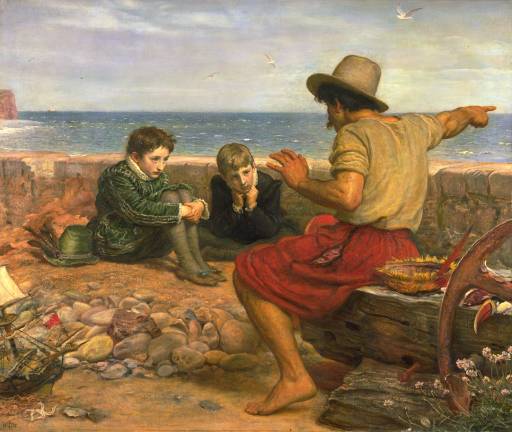
The Boyhood of Raleigh (1871). Painting by John Everett Millais. Source.


Reading Aloud: Why Dog and Cat are Enemies

One of the primary things I noticed was the rhythm of the writing. As I read it, I could imagine a parent or a grandparent telling this story to a child. Reading aloud was more interesting than reading it silently. I'm sure that reading it aloud is closer to the way in which these stories were originally spread. The style is difficult to describe, but it matches Aesop's fables and fairy tales, in that the plot is very straightforward and introduces elements in the same order that they have an effect on the story. for example, the dog and cat are introduced when they plays their roles, rather than being introduced at the very beginning of the story before the plot has actually kicked off. Although these notes are more detailed after having read it aloud, I don't think the story is long enough to make a significant difference. Reading aloud a longer story, such as the Ramayana, would help me create a much more detailed list of notes.

Copy-and-Delete: Bucchettino

Reading Notes
Bucchettino is already shown to be an obedient and thus good kid. Is this penny a lucky reward for his obedience to his parents?
He's thoughtful and thrifty. He knows the value of money.
Now there's an ogre. His rhythmical speaking must be a way in which he lures children to their fates. He's certainly persistent about the figs.
Bucchettino, despite his obedience to his parents, is being punished. Perhaps the moral of the story is to obey parents and not strangers.
Bucchettino is a clever boy. He's saved by his intelligence.
After being tricked by the ogre, the boy tricks the ogre.

This strategy is similar to the way in which I create my reading notes. That is, I'll add notes after reading a few paragraphs rather than after reading the whole chapter or section of chapters. It lets me provide a more detailed analysis and allows me to see what I was thinking after such and such paragraph when I'm reviewing those notes later.

Use a Timer: Quest for the Throne

At first, I read through the story and the author's note. After that, I read through the section about the king's curse.  One addition that would be interesting for the story is for some of the undamaged cargo to wash up on the shore. Through the items that the residents find, another mystery concerning the survivor's past could be created. A longer description of the king's immoral deeds would be a welcome addition. Unfortunately for this reading style, I found myself trying to beat a clock more than focusing on the story. This is similar to my mindset during tests. I'm so worried about finishing in time that I'll think more about the clock than the material and begin to overlook smaller details.

Conclusions
Overall, I have to rank the reading techniques in the following order:
1. Copy-and-delete
2. Reading aloud
3. Use a timer

By thinking in terms of individual lines and paragraphs, rather than the story as a whole, I feel like I can make a more detailed analysis. Any time constraints simply distract from the material. I would have read the story within ten minutes regardless of whether I had actually set a timer, but setting that timer gave me one more thing to think about and to distract me.

The Celestial Weapons

Rama fires an arrow at a foe. Illustration by Evelyn Paul (1911).
Originally published in Stories of India's Gods and Heroes (1911). Source: Wikimedia Commons

Once upon a time, the great warrior-prince Rama defeated an enormous horde of rakshasas, led by Subahu and Maricha. The battle was fierce, but with the help of celestial weapons called down the sage Vishwamitra, Rama was able to defeat them. However, despite this victory in battle, he had another problem, one that was more suitable to a king: the jealousies and intrigues of his subjects.


Once returned to their world, the weapons rejoiced at the victory over the rakshasas. They hadn’t been used in thousands of years and it was finally good to help defeat evil and serve a great warrior. That is, most of them rejoiced. There were a few among them who felt as though they hadn’t received enough credit for their valor. The most vocal among these was the celestial spear. He had been through most of the battle and was jealous when he saw the other weapons praising Rama. He took some of his closest friends to a private spot and told them his concerns. They were wary at first but, after a persuasive speech, they began to agree with the spear’s point: that the weapons hadn’t received as much credit as they deserved for defeating the rakshasas.


The spear called together a meeting of all of the weapons. They were confused as to why the spear would call a meeting. He was generally standoffish and rarely spoke to any who wasn’t his friend. Even then, he spoke without manners and was wont to use uncouth words.


After calling the meeting to order, by rattling himself against his best friend, the dagger, the spear spoke up. "I’m sure you’re wondering why I, the spear, would bring together a meeting. I assure you that it is a most important topic. I'm not sure Rama is giving us the proper credit for our bravery. We were actually the ones who killed the rakshasas. Rama only aimed us. He only pointed us in the direction of the rakshasas."


To this, the saber, who held the spear in low esteem, replied, "But Rama is a brave and clever warrior. Surely we must give him most of the credit. We are, as we promised him, but tools in the defeat of evil. Are you not happy, spear, about our defeating evil? Would you rather have rakshasas overrunning ever place on earth? Do you know how dreadful such a world would be?"


At this, a few of the other weapons applauded and shouted their approval. This only infuriated spear, who replied angrily, "I never said that I wanted the rakshasas to overrun the world, You've seriously mischaracterized my argument. You’re putting words in my mouth." A few more claps came from the crowd, these weapons having changed their minds on the subject at hand. "Of course I'm happy that there are fewer rakshasas.”


At this, the rest of the weapons took up a series of cheers. It was all the spear could do to bring the meeting back to order. It was growing red with anger and rattling a great deal.


"What we are discussing,” the spear shouted over the crowd, “is whether Rama deserves all this praise. I believe that he is simply the ship at sea, while we are the wind that pushes him. Without us, Rama wouldn’t go anywhere."


"Yes," cried the staff, "but where would the wind be without the ship? It wouldn’t have anyone to help. All it would do is brush against trees and bushes. How useless the wind would be!"


The mace, who was close friends with the spear and stood beside it, said, "It would scatter the seeds of plants and help to grow forests!" The mace struggled to make itself heard above an audience which was growing increasingly restless.


After some time, the spear managed to gain control of the meeting. "Let's get back on track. When has Rama ever thanked us for saving his life? When has he ever acknowledged how vital we are to his mission?"


The saber said, "Why should he thank us? If anything, it is us who should be thanking him! Without Rama, we would never achieve glory in battle. Without Rama, we could never help create history!"


The mace whispered to the spear, "He's right, spear. Without Rama, we couldn't even consider ourselves true warriors. We would be no better than twigs from a tree."


The spear reluctantly agreed. He knew that, if it weren't for Rama, nothing would have happened. They would never have become part of the Ramayana, an epic of which Brahma had recently foretold.


The spear turned to the crowd and said grudgingly, "What my friend the mace says is true: We need Rama in order to gain glory."


“And Rama needs us,” the mace agreed. “Neither we nor Rama can work alone. We are both great, but a warrior without a weapon is like a house without walls, open and exposed to the elements. A weapon without a warrior is like the frame of a house without any inhabitants: useless.”


The weapons, having debated at length and now agreeing on the fundamental point, decided to send an envoy, the mace, to earth. There, it spoke to Rama.


"Blessed Rama, we wish to thank you for helping us achieve glory in both worlds. You are a courageous fighter and we are proud of having helped slain so many rakshasas."


Rama, courteous and honest as ever, replied, "I could not have won without you, my strong celestial weapons. We have all played a vital role in defeating the horde of rakshasas. We each have our place, We do not have a choice in our position. Dharma is not to be changed by man or weapon. We must accept it as it is. Be happy that you, the weapons, and I have been granted such esteemed roles.”


The envoy returned to the celestial weapons and told them what Rama had said. The weapons rejoiced in the knowledge that, not only had they played an essential role in the battle, but that Rama, prince and future king, had praised them so highly. They recognized the role of dharma in their lives and were glad to be placed so high. They expected even more good to come of their partnership with Rama.


Author's Note


In contrast to the first version of this story, I decided to detail more of the complaints of the weapons and how these concerns were finally put to rest. Dharma plays an important role in Hinduism and Buddhism, among other religions and philosophies. While dharma has broad and often varying definition, it can be generally described as the idea that each person has a position that has been determined for them. Rama is destined to be a warrior and king, while, say, Jatayu was destined to help Rama fight Ravana. Dharma is also a moral consideration in that to accept its directives is itself a moral deed.


The weapons, when called down by Vishwamitra, proclaim loyalty to Rama and pledge to help him whenever he needs them. Given this pledge of loyalty, it seems likely that the weapons are sentient and thus would have some thoughts of their own. I thought that it would be interesting to show some characters who, rather than simply adoring Rama or fervently hating, hold mixed feelings concerning him. It seems only natural that at least one of those beings (be it a man or a celestial sword) would be jealous or feel as though they weren't given enough credit. It's clear that the epic centers around Rama's exploits. By writing from the perspective of the celestial weapons, I've provided, not exactly a backstory, but an elaboration of those events surrounding Rama during his adventures.


Bibliography


“Dharma.” Wikipedia. Source.


Various authors. Ramayana (public domain). Source.

Tuesday, September 13, 2016

Story: Kumbhakarna's Diary

The rakshasas try to wake up Kumbhakarna (17th century). Author unknown.
Link.

Dear Monkey,

I’m not one for keeping a diary, but I’ve so many things that I want to put down. I can’t keep all of these emotions bottled up. I think that if I did try to keep everything contained, I would only end up exploding one day and hurting everyone around me.

The problem started a long time ago, when Ravana wanted us to meditate on Brahma so this god would grant us each a boon. I was relatively accepting of this. Who wouldn’t want a gift from Brahma? On the other hand, I didn’t want to spend so much time meditating. I’d rather go hiking or knit a sweater. Imagine how many saris I could have made for the rakshasas dames had I spent that time in Lanka! Eventually, we had thought enough on Brahma that he appeared and said he would grant us our boons.

When Brahma asked what I wanted, I tried to say, “better skills in painting,” but what came out of my mouth was something completely different: “to sleep for twenty-four hours every day.” As I learned later, the goddess of speech, Saraswati, forced my tongue to ask for something foolish. Ravana, to his credit, protested. He wanted that “boon” to not be granted. Brahma relented (somewhat) and made it so that I would wake up for a short while every six months. As an aside, that’s one of the reasons I don’t write in this diary much.

Well, a long time passed and Rama appeared on the scene. He and my brother, Ravana, got into quite the tiff. Ravana told me all about it and called Rama names, but the prince seemed fine to me. He hadn’t done me any harm, anyway. What turned me against Rama was when he invaded Lanka with his monkey armies. I’m more peaceful than your average rakshasa, but that really got my goat. I had never invaded Rama’s kingdom. Why should he invade mine?

The battle had raged on for a while by the time Ravana and his rakshasa servants were able to wake me. I had been having a dream about some delicious curry dishes and, not having eaten for almost six months, I was famished. The rakshasas made me mountains of food. They weren’t the best chefs, but it was certainly filling. Once they had buttered me up like this, Ravana told me that Rama and his armies were at the castle walls. Naturally, I was pretty angry. With the help of a few hundred rakshasas, I prepared myself for battle and went out to meet Rama. He didn’t even wait to hear me out. He just started throwing his weapons at me. How rude! He may be a great warrior, but he’s no diplomat!

Rama and his armies tried to hurt me for about an hour. I’ve got skin several yards thick, so nothing could hurt (or so I thought). I laughed off all they threw at me. Sugriva the monkey king eventually tore off my ear, as though Rama, already deaf to words of peace, wanted to make his opponent literally deaf. It hurt terribly and I was in shocked. That’s when Rama pulled out his secret weapon: some magic arrows. He nocked these arrows and pulled back the string. Then he fired them at me!
I felt like I was going to die, the arrows were so sharp. I fell down on the ground and was unconscious for the next six months.  They must have thought I was dead, as they never even bothered to check my body for a pulse. When I woke up, Lanka was in ruins. I’m writing this from palace, only half-destroyed. I’m glad I was able to find Monkey. I can’t imagine where I’d find another giant diary.

I can’t say I hate Rama anymore. My brother was certainly a jerk about kidnapping Sita, but he would never have actually hurt her. He was probably just playing one of his games. Once he got bored taunting Rama, he would have dropped Sita off. Maybe he went too far this time. Rama and Ravana should have talked it out by reasonable people. There wasn’t any need to kill thousands of rakshasas and burn whole towns to the ground.

It looks like my waking hours are coming to an end. In a few minutes, I’ll fall back asleep for another six months. I can barely keep my eyes open already.


Author's Note

Like one of my previous stories, I used a diary/journal entry to tell the story of a minor character. After reading an Amar Chitra Katha comic book about Ravana's brother, the giant Kumbhakarna, I thought that he got the short end of the stick. Ravana got to rule over Lanka and go wherever he wanted, but Kumbhakarna was stuck sleeping most of the time. I wanted to give Kumbhakarna an internal life of his own and present him as someone who was more inclined to art than to war.


Bibliography

Rao, Subba, and Das, Nandini. (2015). Kumbhakarna: The Sleeping Giant (volume 528). Amar Chitra Katha. Link.

Reading Notes: Kumbhakarna & Dasharatha (Tuesday)

King Dasharatha on his deathbed. Folio from an edition of the Ramayana (c. 1605). Link.

In "Kumbakharna," one of the minor characters of the Ramayana is given a more detailed story. Rather than simply being Ravana's brother and minion, Kumbakharna is given a personality of his own and his own motivations. Ravana is presented as being rather careless concerning his brother's "boon" (given to him by Brahma) and rather exploitative of Kumbakharna's enormous size. Kumbakharna is presented as slothful and glutinous, is contrast to Rama's fairness and honorability. In this way, the story provides a moral; that is, it negatively depicts the traits of the Rakshasas and positively protrays those of Rama. In addition, the divine beings are shown as often in conflict with one another, whether directly or indirectly. Brahma's boon to Kumbakharna is made foolish with the help of Saraswati, the goddess of speech.

In "Dasharatha," the king is presented as rash to some degree, but also, in time, fair and truthful. He admits his mistakes. Many of his actions have far-reaching consequences: among them, Rama's fourteen year exile. Dasharatha may be considered virtuous to a fault, due to the fact that his following Kaikeyi's demands led to Rama's exile and the kingdom's downturn. Dasharatha is "avenged" by the fact that, though Kaikeyi did exile Rama, her son was not the ultimate ruler of the kingdom. Instead, Rama eventually takes his rightful place on the throne. Dasharatha is one of the more complex characters. Rather than being purely good, he is shown as usually having the right intentions but, at times, causing hardship across the kingdom.


Bibliography

Chandrakant, Kamala. (2014). Dasharatha: The Story of Rama's Father (volume 570). Amar Chitra Katha.

Rao, Subba, and Das, Nandini. (2015). Kumbhakarna: The Sleeping Giant (volume 528). Amar Chitra Katha.