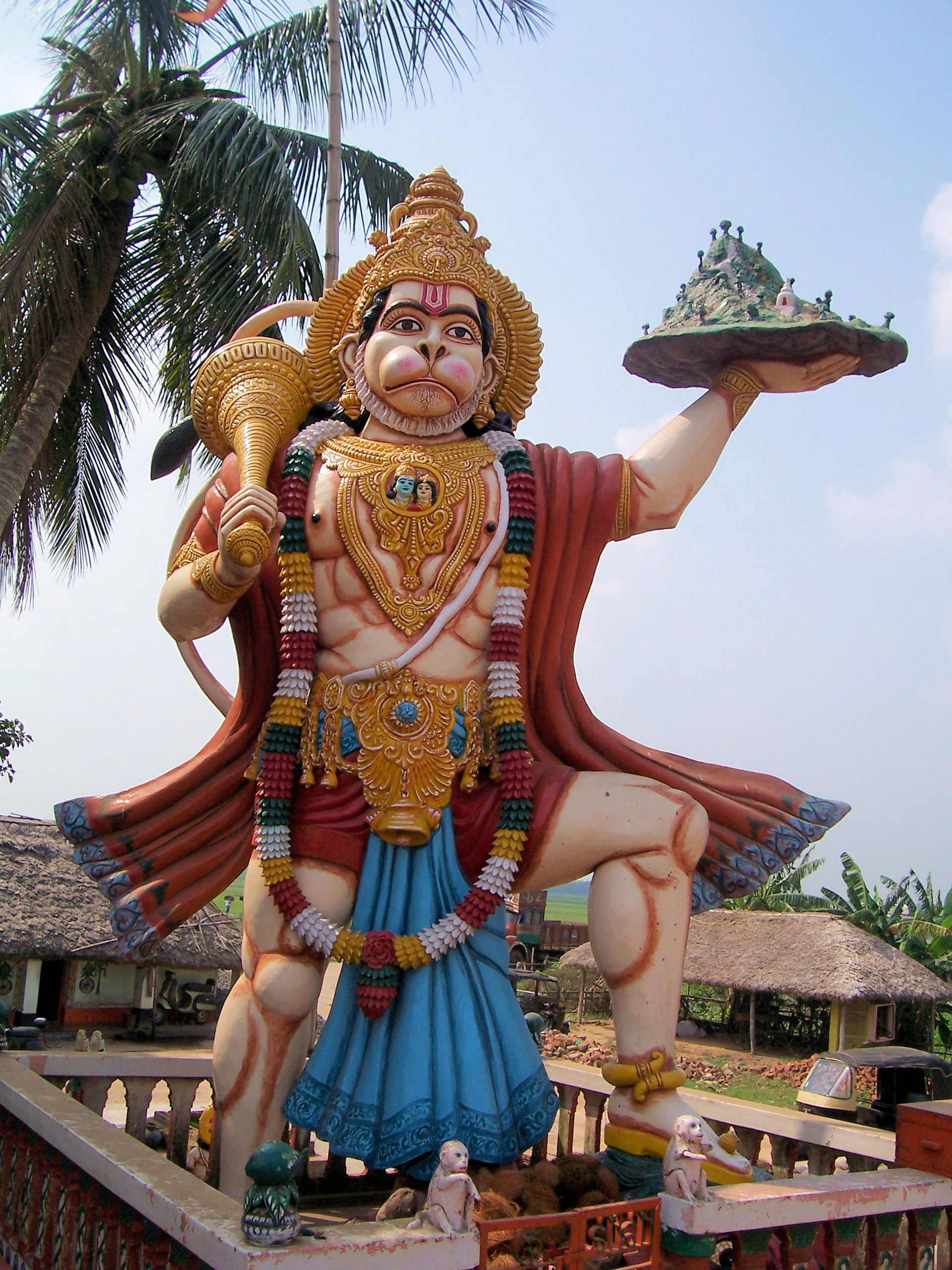
Statue of Hanuman in Haladiagada, Kendrapada, Orissa, India.
Photograph taken by Sujit Kumar (2007). Source.
When Hanuman promised to remain on earth so long as the story of Rama was told, he didn’t expect it to be told and retold as long as it was. He soon figured that the Ramayana would be told long after the Himalayas had crumbled into dust and the Indian subcontinent had split off from Asia. Needless to say, he wasn’t entirely enthusiastic about this. He enjoyed life, for the most part, but one can only eat so many fruit before one gets sick of them. After several centuries, having exhausted whatever pleasures he could gain from food, he moved onto pranks and tricks. To those wanderers who passed by his little hut, he would throw berries and other fruits.
One day, while he was napping on a tree branch, Hanuman heard something farther down the path. It sounded like footsteps, but they were incredibly slow. He listened for a few minutes but the sound remained distant. He soon fell back asleep. He woke again to the sound of these footsteps. This time, he spied, through the foliage, a hunched figure making its way down the path. The figure was muttering some prayer. Hanuman thought for a moment and decided that, yes, he would like to pelt this traveler with fruit. Taking up an apple, he aimed it at the figure’s hood and released it with as much strength as he could muster (which was quite a lot).
The apple hit its mark and the figure began to shout a series of expletives. When it turned to face the direction of the thrower, Hanuman saw that this figure was an old man with a long, gray beard. The monkey felt some remorse at his actions. Had he known the passer-by was a decrepit old man, he would have thrown something smaller. Hanuman leapt down from the tree branch and went up to the man to apologize.
Before the monkey could say anything, the man said to him, “Why in the world would you hit me in the head with an apple?”
Hanuman replied, “I was bored. Living out here can get mighty dull.”
“Only a boring monkey can be bored,” the man said, angrily.
“Boring? I’m not boring.”
“No, not after I place this curse on you: As you may have heard, there are brothers by the name of Pandava who have been wandering these parts for several years. You will remain on this very spot in the road until you have told the story of Rama to one of these brothers.”
“Really?” replied Hanuman. “I also have to stay here on earth until the story of Rama is no longer told.”
“Rama? You must be Hanuman! I’d love to hear of Rama and his great deeds.”
“I will, but only if you break your curse once I’m done telling it to you.”
So Hanuman began to tell the old man the story of Rama. He was just to the part about Jatayu’s death when an enormous rakshasa ran into the clearing. It roared and Hanuman was frightened. The old man, far from being a celestial being like Hanuman had suspected, was but a simple villager, and was nearly powerless against the demon. The rakshasa picked this old man up and swallowed him whole. Hanuman could hear the old man’s cries from inside the demon’s stomach.
“Help me! Help me!” the man cried.
Hanuman was frightened. He tried to leap back into his tree but the old man’s curse held and he couldn’t move off the road. He thought he would die. However, he soon realized the implications of his promise. If he was to remain on earth until the Ramayana was no longer told, he likely couldn’t be killed. He gathered up some of his rocks and began to toss them at the rakshasa. The demon seemed annoyed, but it didn’t go away. Hanuman realized that he may have to fight the demon barehanded. He fought bravely against the rakshasa but was soon swallowed.
The inside of the rakshasa’s stomach smelled of putrid meats of unknown origin.
“Disgusting!” cried Hanuman. He nearly retched.
From somewhere else in the stomach, he heard the old man cry, “Hanuman, is that you?”
“Old man? It is. I was swallowed, too.”
“From what I could hear, you fought very bravely.”
“Thank you. But the fight isn’t over.”
The rakshasa tried to run back into the jungle but it felt an enormous weight in its stomach stopping it. To add to its troubles, Hanuman began to tear, scrape, and bite at the rakshasa’s stomach. The monster made a horrible cry. Hanuman was soon able to tear a hole in the rakshasa’s stomach and all of its contents spilled out.
The old man thanked Hanuman profusely. He said to the monkey, “Is there anything I can do for you?”
“Yes, lift this curse.”
“Oh, I’m sorry, but a curse can’t be lifted by the person who cast. It will only be lifted until its terms have been fulfilled.”
“Great. Well, thanks. I guess you can go now.”
“I will still do something for you. I am a carpenter. I will build you a great house and there you will be able to move about as you wish.”
Hanuman lived in this house for several more years. He was lonely and bored and longed for the day when one of the Pandavas should meet him. One day, while he was sitting in the middle of the road, contemplating all that had happened in his life, he felt a tugging at his tail.
Author’s Note
Like several of my other stories, I chose to provide the story of one of the more minor characters. In this case, the main character is only minor relative to the other characters. Hanuman plays an essential role in the Ramayana, having gathered magic herbs that healed Rama’s soldiers and allowed him to defeat Ravana. In the Mahabharata, Hanuman seems to take on the role of mentor more than he does the role of a soldier. Hanuman is an interesting connection between the Ramayana and the Mahabharata. I thought my story would be able to provide a tighter connection between the two epics.
Bibliography
Various authors. The Mahabharata (public domain). Source.


