Showing posts with label Story. Show all posts

Wednesday, November 30, 2016

Story: The Young Parrot and the Farmer

Screen Shot 2016-11-28 at 4.10.32 PM.png
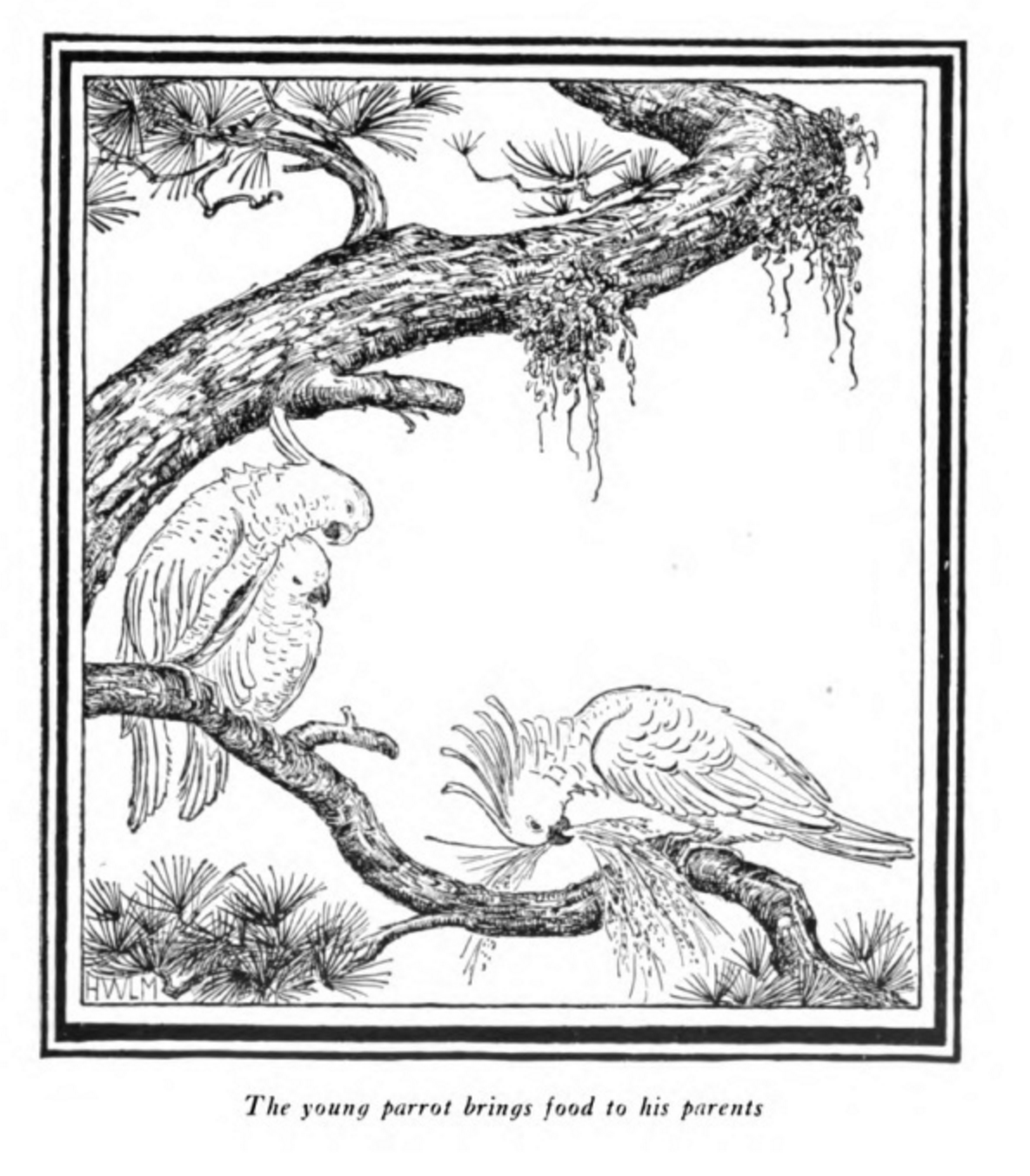
“The young parrot brings food to his parents.” Scene from “The Young Parent.”
Illustration by H. Willebeek Le Mair (1939).


The Young Parrot and the Farmer

One day, a flock of parrots were on a farmer’s field, eating all of the loose rice. However, they left the plants alone. The farmer’s servant was out there and saw one of the younger parrots gathering a great deal of rice in its beak, but not eating it. Once the birds had left, the servant went to tell the farmer about it.
The farmer was surprised by this and said to his servant, “Trap this parrot, but do not kill it. I want to speak to it and see why it is storing away rice.”
Before the parrots returned the next day, the servant set up the trap.
Suddenly, the young parrot felt itself caught. It looked down and saw a piece of string wrapped around its foot. It struggled and bit at the string, but it was unable to free itself. The servant, who had been waiting in the bushes, grabbed this parrot and took it to the farmer.
The bird was frightened but didn’t struggle.
“What is this?” the farmer cried. “A bird who is not scared of humans?”
“No, I’m not afraid of humans” the young parrot replied. Both the farmer and his servant were shocked. A talking parrot? “I’m only afraid of not being able to return to my parents.”
“Why are you afraid of that?”
“Because they cannot fly and if I do not return to them, they will surely starve for lack of rice.”
“So you are storing up the rice in your beak for them?”
“Yes, I store it up each time my flock and I find a field of rice.”
“How honorable,” replied the farmer. “I thought of keeping you as a pet, but I will let you go, so that you may serve your family.”
“Thank you,” replied the young parrot. “I and my kind will never forget this kind deed. If you ever need help, simply whistle three times and my flock will come to your aid.”
Several weeks passed. By now, the farmer’s fields were rich with rice. It was sure to be one of the best harvests in centuries. While the farmer was out admiring his fields, he saw a dark cloud on the horizon.
“How odd,” he thought. “The monsoon season is not close and yet there is a huge dark cloud coming towards my farm.”
As this “cloud” drew closer, the farmer realized what it truly was. The buzzing of the cloud could be heard from miles away.
“Locusts!” the farmer cried.
He despaired at this. It was just his luck that a swarm of locusts would eat his best harvest. He had no idea what to do. He would never be able to stop all of them. The locust swarm landed in his neighbor’s fields and began to eat everything there. The farmer almost lost all hope, but then he remembered the promise that the young parrot had made some time ago.
The farmer whistled three times as loud as he could and soon a whole flock of parrots flew down from the forest.
The young parrot came to him and asked, “What do you need, kind farmer?”
The farmer pointed out the swarm but a mile or two away. He said, “There is a swarm of locusts that has descended on my neighbor’s farm. You must eat all of them or the whole countryside will be ravaged and hundreds will starve.”
The parrots flew off in a hurry. Within a few minutes, all of the locusts had either fallen to the ground, dead, or had been gobbled up by the parrots.
When the young parrot returned to the farmer, the farmer said, “You have saved me, my family, and the entire village. You may eat of my fields whenever you like.”
Every year after this, not a single locust descended on the farmer’s fields and the flock of parrots always had enough to eat.


Author’s Note

I adapted this story from “The Young Parrot,” in Twenty Jataka Tales. In the original story, the young parrot saves rice for his parents, is trapped by the farmer, and is later set free. I decided to expand on this story by having the farmer be rewarded for his kindness. In the original story, the parrot only thanks him for his kindness and flies off. Karma plays a large role in my adaptation. Not only is the parrot set free because of his sense of familial obligation, but the farmer and the rest of the village are saved because the farmer performed a kind deed.  

Bibliography

Noor Inayat (Khan). (1939). Twenty Jataka Tales.


Wednesday, November 16, 2016

Story: The Dullard

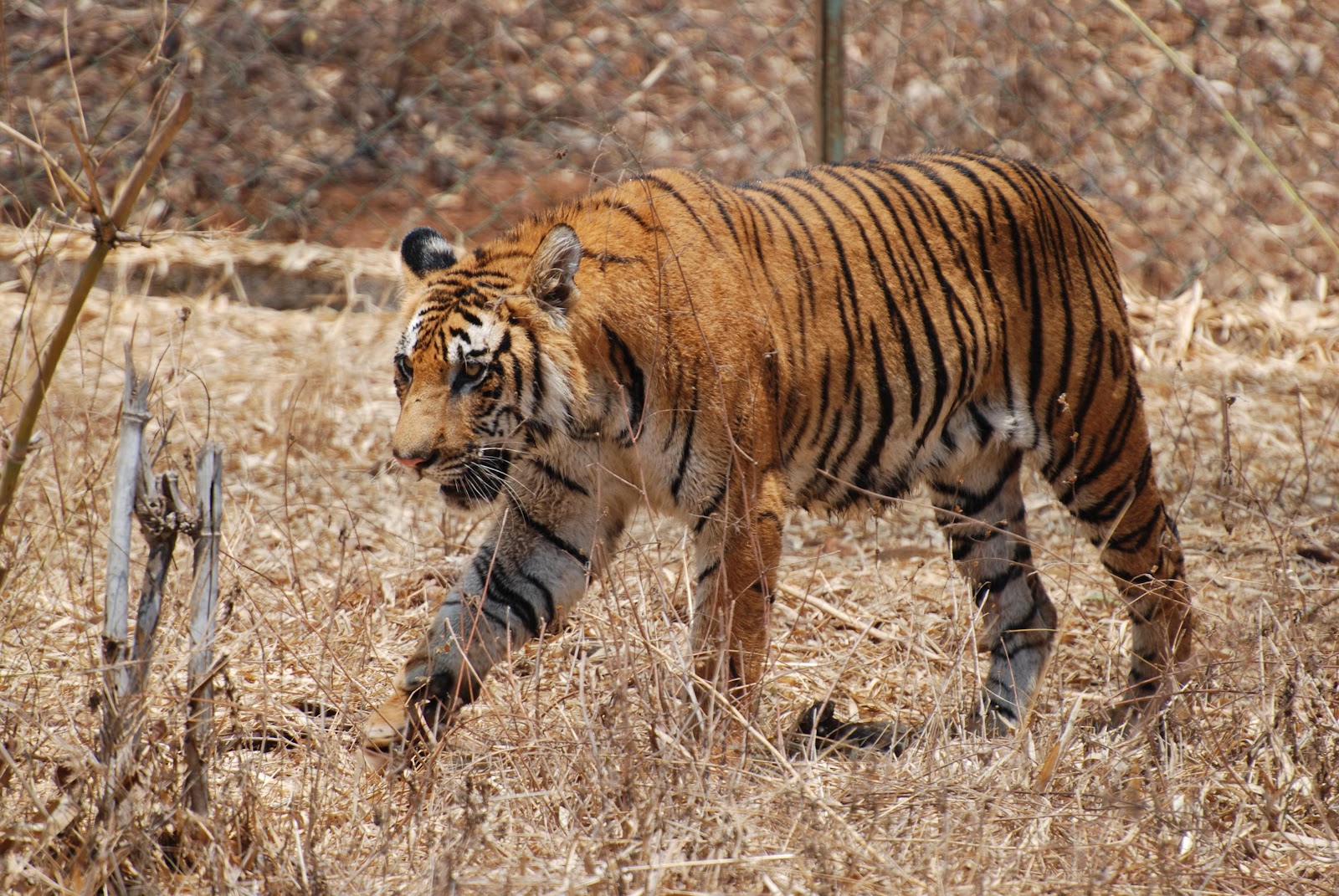
Bengal_Tiger_Karnataka.jpg
A Bengal tiger in India.
Photograph by Paul Mannix (2009).

The Dullard

Many years ago, there once was group of three brahmans. They had each lived in the forest for seven years. During those seven years, they had become knowledgeable in matters related to karma, to dharma, and to all of the underlying truths of life.
Although these three brahmans had lived together for seven years, one of them had always remained an outsider. They called him “the dullard.” They had only let him into their group because they pitied him. They thought him incredibly dull.
One day, the brahman agreed that it was time to leave the forest. They had learned a great deal during their isolation. They thought they could make great use of it by buying and selling goods. They could become some of the wealthiest merchants in the kingdom and, perhaps, gain positions in the king’s court.
Of course, the smarter two didn’t think the dullard would amount to much. Even so, they let him go. It would certainly be funny to see him prove a terrible merchant. In all likelihood, he would lose all that he had within a week.
The three brahmans packed up their few belongings and headed out of the forest. Along the way, they came across a skeleton. The wisest brahman looked closely at the skeleton.
“Why, this is the skeleton of a tiger!”
“How odd,” said the second wisest brahman. “You know what we should do?”
“What?”
“We should bring it back to life. We’ve learned so much in our seven years in the forest. We should able to do that.”
“That sounds a good idea,” said the wisest brahman.
But the dullard disagreed. He said to the two other brahman, “It’s a tiger! If we bring it back to life, it’ll eat all of us!”
The other brahmans laughed at him. “Why would it eat us? Wouldn’t it know a brahman when it saw one? We all know that tigers don’t eat brahmans.”
At this, the wisest brahman used his powers to put muscle and skin back on the tiger’s bones. Then, the second wisest brahman breathed into its mouth in order to restore it to life.
“Ah,” he said. “We are able to bring the dead back to life! Forget being merchants. With those power, we could become kings over all of India!”
Before the brahman could finish his sentence, the tiger leapt at him. The beast tore at him with her claws and soon he was just a bloody pile. The dullard leapt into a tree, where he hoped the tiger wouldn’t be able to get him. Meanwhile, the wisest brahman was trying to calm down the tiger.
“We have brought you back to life, oh tiger! Surely you should be thanking us, not eating us!”
The tiger attacked this brahman too and made a meal of him. The dullard remained in his tree until the tiger had gone away.
Moral: A man with wisdom but no common sense is like a palace with art but no furniture.


Author’s Note

In this story, I adapted a tale told in an Amar Chitra Katha comic book, “The Dullard.” In this tale, a group of wandering brahman bring a lion back to life, only to have it attack them. The dullard of  the group is the only one who survives. He warned them, but they didn’t listen. My story is a pretty close adaptations of the original. I may eventually add another passage or a sequel about how the dullard came to be one of the most revered men in the kingdom.


Bibliography

The Dullard. Amar Chitra Katha, v. 585.


Tuesday, November 8, 2016

Story: The Bear and the Bees

Natural_Beehive_and_Honeycombs.jpg
A beehive hanging off of a tree branch in India.
Photograph by Muhammad Mahdi Karim (2012).

One day, a bear was walking in the jungle when he encountered a cat. The cat was trying to climb a tree in order to reach a beehive which hung on the highest branch. Every few seconds, a bee would swoop down and sting the cat. At this, the cat would fall back down. Even after a dozen stings, the cat still tried to climb the tree.
So distracted was the cat by her activity that she didn’t even notice the bear approaching her. The bear was rather bored and decided to play with this cat. He took his great paw and swiped at the cat. This certainly got the feline’s attention.
The cat yelped and shouted at the bear, “What are you doing? Trying to kill me?”
“No,” the bear replied, “I was only trying to play. I’m so bored and there’s nothing else to do.”
“Bored, eh?” The cat began to think of a plan by which to get the honey in that beehive. She didn’t think much of the bear’s intelligence and assumed he would do anything he was told. “I know something you can do,” the cat said.
“What is it?” asked the bear.
“You can climb this tree and get the beehive for me.”
“Why do you want to get the beehive?”
“It’s filled with a sweet golden goo.”
“That sounds tasty,” the bear said, licking his lips.
“It certainly is.”
“Can I have some if I help you get it down?”
The cat hadn’t expected this, but half of the honey was better than nothing at all. “Alright,” she said. “We’ll split the honey once you knock it off the tree.”
The bear started to climb and soon reached the top branch. The bees by then had lost all of their soldiers. Only the queen, her advisors, and the workers remained. When the bear started crawling across the branch in order to reach the beehive, he heard a tiny buzzing in his ear. He swatted by his ear but the buzzing resumed soon after. This buzzing almost sounded like speech. He listened more closely and could actually make out something.
“Bear, you must help us!”
Befuddled, the bear asked, “Who’s talking?”
“I am the queen of this hive. We are in dire straits. We have lost all of our soldiers and our hive is completely defenseless.”
“What would you have me do about it? I am only a bear.”
“You can guard us from other animals. You are big and strong and no animal would dare challenge you.”
“What about the cat? She asked me to knock your hive down so that she and I could split the honey inside.”
“If you do that, you will only get honey once. If you defend us, we will give you honey every day.”
“Will I get more honey that way?”
“Yes, you will, in the long run.”
At this point, the cat had grown impatient. She yelled, “What’s going on up there?”
“Nothing,” the bear replied. “I’m almost there.”
The queen bee said to the bear, “First, we need you to scare off the cat. She will probably take the hive for herself while you’re still in the tree.”
“I don’t think so. She seems trustworthy to me.”
“She’s not trustworthy at all,” replied the queen bee. The royal advisors, who had gathered around her, agreed with this statement.  
The bear wasn’t so convinced. In fact, he was rather angered by this statement. He took his great paw and swiped at the hive. It was now hanging by a thread. He swiped again and the whole thing came crashing down.
“Oh no,” the bear cried. “What have I done?”
The cat said to him, “You’ve gotten me a great deal of honey!” With that, the feline took the hive in her mouth and ran off.
The bear knew he should have listened to the queen bee. Had he been more patient and level-headed, he could have gotten honey everyday. Now, he had nothing at all.

Author’s Note

I didn’t have a specific story in mind when I was writing this. It’s in the style of the Fables of Bidpai. That is, the characters are all animals and a moral lesson is provided at the very end. Of course, there’s a trickster character who misleads the protagonist, the bear. I considered having the bear act as a defender of the bees for some time before realizing he could have the honey all at once. However, this story seems to work better in that the bear doesn’t come to this realization but rather is tricked into knocking the beehive down. Either way, he learns a lesson about patience and not acting rashly. I may add a frame story in order to make the moral more clear.

Bibliography


Wednesday, November 2, 2016

Story: The Tortoise and the Heron

Indian_Pond_Heron_(Ardeola_grayii)_in_Breeding_plumage_walking_cautiously_in_Kolkata_I_IMG_7936.jpg
An Indian pond heron. Photography by J.M Garg (2007).


Many, many years ago, there was a large pond. This pond was fed by a wide stream which swept down from the mountains, through the jungle, across the plains, and into a river. It bubbled and gurgled all day, bringing fresh water to those plants and animals which lived in the pond. The land around the pond was remarkably fertile and all kinds of things were able to grow in that little shaded pond.
Among those animals that lived in the pond, the oldest of them all was the tortoise. He had been there far longer than anyone else. In fact, he had been there so long that he couldn’t remember when he had come here. He might have always lived here, but no one could say for sure. So wise and venerable did he seem that the animals treated him as something of a god-king. They thought he could commune with the other gods and ask for favors.
During one particularly hot summer, the stream which fed this pond started to dwindle. After a few weeks, the stream dried up completely and all that could be seen was the rocky bed. Pretty soon, the pond itself began to dry up. All of the animals were frightened. Of those animals which lived in the water, the fishes were the most frightened. They cried out to the tortoise, expecting him to have some wise plan. Surely he had seen days such as this, when there wasn’t enough rain to sustain the pond. Perhaps he knew how to bring the water back.
“Oh, wise tortoise!” they cried. “Why has the stream dried up? Please help restore it! If you don’t, we shall all die.”
The tortoise cleared his ancient throat and replied, “It has dried up because not enough of you have brought me the choicest plants. Go forth! Bring back the best herbage and I shall restore the stream.”
All of the little animals helped find the choicest plants for their tortoise. When they brought them back, he made quick work of all the herbage. Rather than being satisfied with this, he told them to bring back some ripe, juicy berries. They did this and he ate them even more quickly than he did the plants. He then demanded even more food. So did the animals eventually strip their pond and the surrounding land bare. There wasn’t anything for the tortoise’s subjects to eat now.
The tortoise still demanded food, but those few remaining animals (so many having perished of hunger) told him there was nothing left. The tortoise thought he would be able to save the pond, so confident was he in his genius. He soon realized that nothing could be done.
One day, while the tortoise sat despairing, a heron appeared at the pond. Sh saw the predicament all of these animals were in.
“Who is your king?” she asked one of the fish.
“The tortoise,” the fish replied. “He is the wisest king we could possibly have.”
The heron went to the tortoise and said, “I see that this pond is close to drying up.”
“Yes, oh, yes!” the tortoise cried, unable to contain his tears. “I thought I could save it but no rain has fallen and the stream is still dry.”
“I know of another pond not too far from here,” said the heron.
“Really?”
“I could take you and your subjects there. You would only have to climb in my beak.”
“How can I be sure you won’t eat all of us?”
“Why would I do that? I have seen how desperate you and your subjects are, so I must help you. It is my duty as your fellow animal.”
The tortoise agreed, but on the condition that he would stay behind until the last animal had been moved. He would be able to help coordinate this exodus if he stayed behind for some time. The fish all gathered in little schools in order to be picked up by the heron and flown to the new pond.
But the heron had no intention of bringing them to the new pond. When the heron was out of the sight of the old pond, she would gulp down whatever creature she had in her mouth. She flew back and forth several times before it was the tortoise’s turn.
As the heron was flying off towards “the new pond,” the tortoise looked down and saw all of the brilliant white fish bones scattered along the fields. He cried out and the heron tried to gulp him up. Unfortunately for the heron, the tortoise was too big to swallow in one gulp and started biting the bird’s tongue. The heron tried to get the tortoise out of her mouth now, but the tortoise held on tight to her tongue. Soon, the heron was forced to land by a small pond and to let the tortoise out. But before the tortoise left, he made sure to bite off the heron’s tongue.
“Both you and I have taken advantage of desperate animals. Of that, we are both guilty. But I thought what I was doing would truly help them. You, on the other hand, always intended to eat us. For that, you are to be cursed for the rest of your days. No longer do you have a tongue with which to deceive others!”
With this, the tortoise climbed into the new pond and the heron flew away, angered that he had been so thoroughly deceitful to the tortoise and the fish.


Author’s Note

This story is a combination of two folk tales from Dutton’s Fables of Bidpai: “The Tortoise and the Geese” and “The Crane and the Crab.” The theme of taking advantage of someone in desperate circumstances is present in my own story, while the carrying of aquatic creatures by birds is also present. In my own story, I decided to make the tortoise somewhat of a bad creature in order to allow him a redemption at the end of the story. In this story, while the tortoise does deceive his subjects in a way, he is able to finally suffer from that same deception. He repents of his terrible deeds and becomes a better person because of it. The heron, on the other hand, must go through life with the mark of her deception.


Bibliography

Wednesday, October 26, 2016

Story: The Master Carpenter


Illustration by E. Boyd Smith.

One day, many thousands of years ago in a distant country, a young carpenter, Rajendra, was making a long table as a gift for his new bride. He spent all day crafting it, but was never able to get it how he wanted. It was always a little too rough or a little too wobbly for his taste.
Each day, a great many neighbors would come by Rajendra’s workshop to see how his table was coming along. They would look through the open window and talk with Rajendra. He had made progress and it was a decent table, but the carpenter was never satisfied with it. True, the villagers thought, it wasn’t fit for a king, but it would do well enough for a young man and his rather modest family.
After a year of working on this table and trying to perfect it, he gave up. He had accidentally cut a gash across his palm with the corner of the table and this proved the last straw. He moved on to other projects and never told his bride about the table. Nor did he tell the neighbors that he had given up on it; he was embarrassed to even think about it.
One day, when the neighbors came by to see how Rajendra’s table was going, they were astonished. It was sanded so well that nary a bump could be felt on its surface. It was lacquered so well that it shone as brilliantly as the sun. One of the men sat on it and found that there wasn’t even a hint of wobble to the table.
They shouted for Rajendra to come talk, which he did.
The eldest among them asked, “Rajendra, how did you create such an amazing table?”
“I…” Rajendra turned around and saw what looked like his table, but which shone brilliantly in the morning light. He pressed his hand against it and saw that it was extremely sturdy.
“Surely,” the eldest continued, “you are a master craftsman.”
Rather than telling them the truth, Rajendra claimed the work as his own. Each morning  after this, Rajendra would wake up to find that whatever project he had started the previous day would be completely finished. He thought he must be a master craftsman after all, but only when he was sleeping. He figured that he had been crafting the amazing furniture in his sleep before returning to bed.
So popular did Rajendra’s pieces of furniture become that even the royals started to make orders for it. Rajendra made a great deal of money off of these orders. Soon, he and his wife had more money than they knew what to do with.
On one particularly stormy night, two pilgrims from a foreign land showed up at Rajendra’s door and asked for shelter. Now, Rajendra’s house was still very small and could barely hold he and his wife. He told the travelers he would house them, but they would have to be content with the workshop. Being perfectly content to be out of the rain, they accepted Rajendra’s offer. He showed them to the workshop, which stood a few hundred feet from the house.
In the middle of the night, these two travelers were woken up by the sound of saws and hammers and sanding. Before fully waking up, they thought it strange, if not rude, that the carpenter should be working at this hour. They stood up and spied a monkey at work in the shop. It was running around, grabbing tools, measuring logs, and doing all that a carpenter did.
“This is surely a brilliant monkey,” one of the men said. The other man agreed.
In the morning, the two men continued on their way and told each person they met about the brilliant monkey in Rajendra’s workshop. Before the day was through, all of the villagers had heard the story of the carpenter monkey. In the evening, when Rajendra came out of his workshop to speak with the other men of the village, they all laughed at him.
“Why are you laughing at me?” he asked.
They replied, “You are no master craftsman! You have only taken credit for the work of a monkey!”

From that day on, Rajendra vowed to never take credit for someone else’s work. He also began to appreciate his own work more. True, it wasn’t perfect, but he had made it himself.  


Author's Note

This is an adaptation of the story, "The Carpenter and the Ape" from Dutton's Fables of Bidpai. It's quite a departure from the original story. In the original story, the monkey tries to act like a carpenter, but soon gets its tail stuck between two pieces of wood and is punished by the actual human carpenter. In my own version, I decided to give the monkey a much happier story. Rather than being quite foolish, this monkey is actually a prolific carpenter and tremendously skilled. Nothing bad happens to the monkey in my own story; instead, the carpenter receives his own moral lesson.


Bibliography

Tuesday, October 18, 2016

Story: The Elephant and the Dog

The elephant is reunited with the dog.
Illustration from More Jataka Tales by Ellsworth Young (1922).


Once upon a time, the king of India had a whole stable of elephants. There were a dozen of them and all they had to do most days was to eat hay and grass and play tricks on one another. It was a happy life, for the most part.
One day, a dog snuck into the elephant stable. All of the elephants were afraid of the dog. It had sharp teeth and looked just like a wolf. Only one elephant didn’t panic when it saw the dog. This pachyderm was more intrigued by the dog than afraid of it. It went up to the dog and asked what the small wolf-like creature’s name was.
“I am Fido,” it replied, shivering, obviously afraid of the huge creatures which stood in the stable. It thought it would be eaten.
The elephant, being very bright, could tell that it was afraid and said to the dog, “Don’t be afraid. We are all vegetarians here. I’ll talk to my friends and tell them that you are a friend.”
The dog thanked it profusely.
In time the dog and the elephant became great friends. The dog slept in the elephant stable every night and they played games together everyday.
One day, a farmer saw the dog by the stables and asked the elephant-keeper whether he could buy the dog. The elephant-keeper didn’t like the dog, thinking it would spread fleas to the king’s elephants, so he sold it to the farmer for only a few rupees. The elephant became very sad. It barely ate and barely slept.
Soon after, a war started between the elephant’s king and the king of a distant. This was the first time the elephant had been to war and it was extraordinarily frightened. When it was back in the king’s camp, it saw all of the dead bodies and the dying men being carried in carts. The elephant only wanted to go home. It had had enough of this war.
As it turned out, the dog, having been just as sad as the elephant and not wishing to do any work, had been sold by the farmer to a soldier in the other country. It served as a war dog in the army and it was only with a great deal of prodding that it would attack the opposing army.
On the second day of the battle, the elephant was walking across the field when it spied a great pack of dogs running towards it. The elephant reared up, ready to smash the dogs, not because it liked war, but because it didn’t want the king, who was riding on its back, to be hurt.
The dog was the leader of this pack and recognized the elephant. It stopped and so did the dog soldiers under it. They asked their captain what the problem was. It replied that the elephant had been a good friend years earlier.
The kings of both sides saw this and considered it a miracle. They both called for a ceasefire. The two men, being very wise, talked about the issue which had caused this war. They saw that it had been a misunderstanding and decided to ally themselves, should some enemy attack them or threaten war. From them on, each year, the elephant and the dog spent six months in the elephant’s king’s palace and six months in the dog’s king’s palace. They never again had to go to war and they remained great friends for the rest of their lives.


Author’s Note

In this story, I took a Jataka tale and decided to elaborate on some of the circumstances surrounding the animals’ reunification. Rather than simply being lonely and the king recognizing this, the elephant and the dog must go through the terrible circumstances of war in order to find each other again. Their reunification also offers a chance of reconciliation to the two kings. They wisely decide that if the “war” elephant and the “war” dog can get along, then their two kingdoms can too.

Bibliography

Ellen C. Babbitt. More Jataka Tales. 1922.