Showing posts with label Reading Notes. Show all posts

Tuesday, November 29, 2016

Reading notes: Twenty Jataka Tales (Part B)


The flying horse from “The Goblin Town” flies the sailors home. Illustration by H. Willebeek Le Mair (1939).

The Two Pigs
  1. Even though the mother is surrounded by drunken men, she refuses to give up her adopted pig-children. Loyalty to family is a common theme in these tories.
  2. The men treat the pigs as people and are rewarded with a more peaceful society.

The Patient Buffalo
  1. This monkey is extremely annoying. Surely, the buffalo will get some form of justice.
  2. The buffalo is rewarded for not using his great power to hurt the weak or act sadistically.

The Sarabha
  1. Although the king tries to hunt the Sarabha and kill it, the Sarabha tries to help him.
  2. The Sarabha sees the king suffering and knows that it must help him as it would a family member.
  3. This king does not forget the help he has received. For every good deed, the person or animal who performed it is rewarded.

The Goblin Town
  1. I think the sailors who stayed are justified in that decision. If strange horse-bird creatures flew down from the heavvens, I’d be wary of riding it.
  2. How will the men who stayed fare? Will they be eaten by goblins or will they be able to fend the goblins off?

The Great Elephant
  1. The elephant sacrifices himself when he sees men in dire need.
  2. The elephant gets the short end of the stick in this situation. Being remembered doesn’t seem like a great reward for sacrificing himself.
  3. What would happen if the elephant had played a trick on them and never sacrificed himself? What if he had just lied about the elephant body because he was mischievous?

The Quarrelsome Quails
  1. This story is a lot like the other animal king ones. If the king’s subjects listen to him, they will never be harmed.
  2. The quails who cause internal strife in the flock are punished with death.

The Forest Fire
  1. The little quail may not be physically strong, but he has enough power to push back flames.
  2. I expected the quail to die because he didn’t do what his parents wanted and eat the insects.

The End of the World
  1. The hare overreacts, but he isn’t punished for it.
  2. He’s made an honest mistake and the lion seems to forgive him.

The Golden Goose
  1. While a king may be majestic, nothing lasts forever.
  2. The goose seems to indicate that wealth and promises are beholden to the passage of time.

The Noble Horse
  1. The horse asks for mercy for the other kings.
  2. This mercy is likely given only because the horse was great in battle. How would the horse’s request have been received if the horse hadn’t done much?

Bibliography

Noor Inayat (Khan). (1939). Twenty Jataka Tales

Monday, November 28, 2016

Reading Notes: Twenty Jataka Tales (Part A)

Screen Shot 2016-11-28 at 4.10.32 PM.png


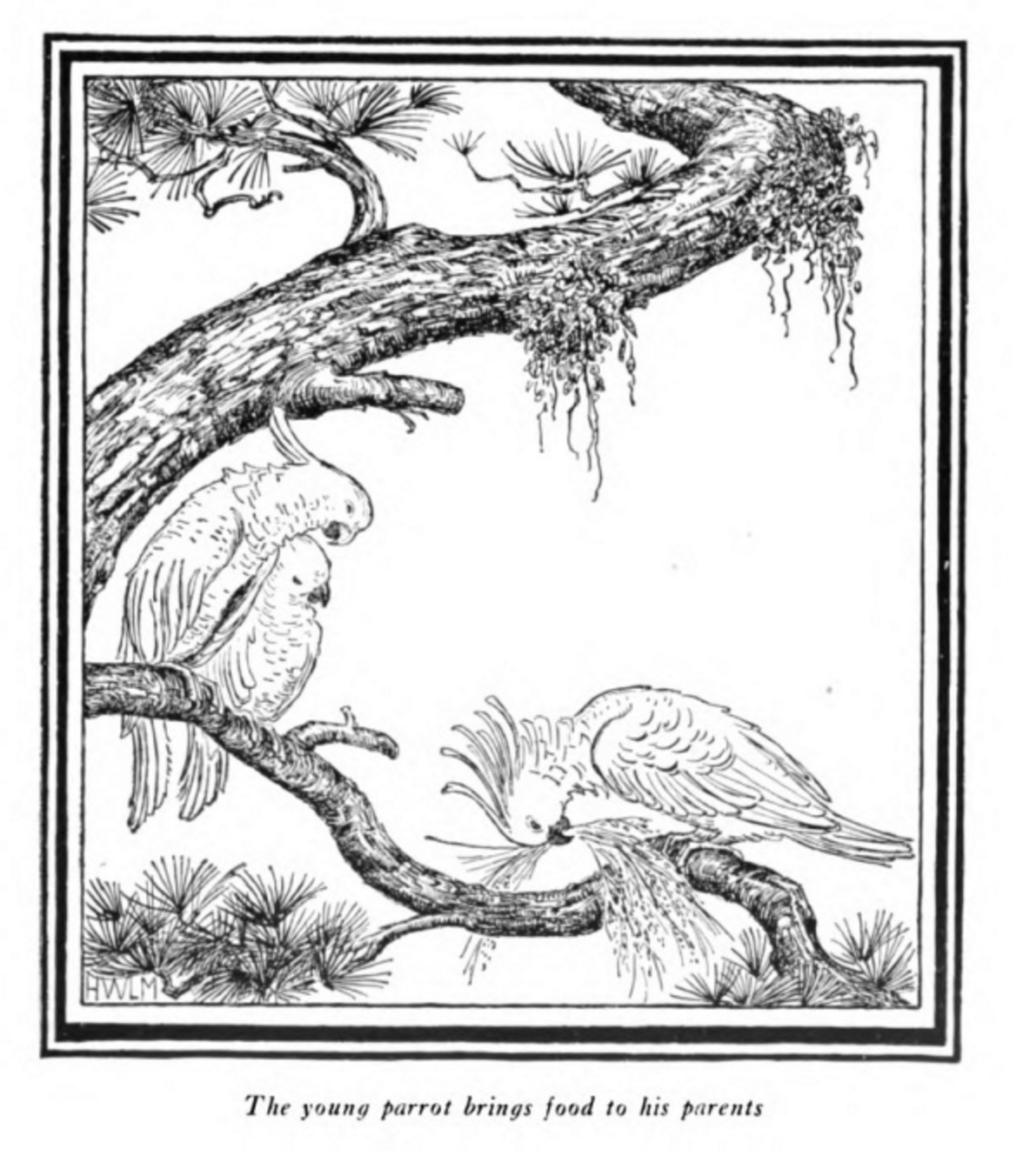
“The young parrot brings food to his parents.” Scene from “The Young Parent.”
Illustration by H. Willebeek Le Mair (1939).

The Monkey-Bridge
  1. These monkeys live in a paradise. Given the nature of stories like this, it’s likely that this paradise will be destroyed due to one of the monkey’s carelessness.
  2. Is the king greedy for the fruit or appreciative of its greatness?
  3. The humans are soiling previously untouched nature.
  4. The monkeys were careless and so are punished. However, their wise king will help them survive.
  5. The humans and the monkeys are punished for intruding on nature and having allowed this intrusion, respectively.

The Guilty Dogs
  1. Like the previous story, there is a wise king who wants to protect his subjects. In most of these stories, all of the problems could be solved if the subjects had only listened to the king.
  2. However, in this story, one of the kings (the human one) is rash. It is only through wise arguments that he comes to the proper decision.

Banyan
  1. Mercy will probably be rewarded.
  2. The king also decides to spare the deer. As always, mercy proves more honorable than violence.

The Tortoise and the Geese
  1. The tortoise was rash in his speaking.
  2. He’s punished for speaking (or trying to speak) in anger at the children.

The Fairy and the Hare
  1. Each of the animals is generous, but the hare is the most generous among them.
  2. This is because he offers, not his property, but his life, in order to help other people.
  3. Of course, there’s someone (a fairy) there with the power to test him and punish him or reward him.  

The Golden Feathers
  1. Why did the husband not reveal his identity? That would have ensured that he wasn’t forcibly plucked of his feathers.
  2. The mother is ungracious for fortune’s gifts and is punished for it. Are the daughters punished for not stopping her?

The Young Parrot
  1. The other parrots might be punished for not helping the young parrot and for being cowardly.
  2. What would happen if the field-owner needed help in the future? Doesn’t he deserve something in return for having let the young parrot go?

The Empty Lake
  1. With a good enough king, it seems that the people will never suffer long.

The Swan Kingdom
  1. It is good to be wary of too beautiful lakes.

The Master's Test
  1. This was adapted in one of the Amar Chitra Katha comic books.
  2. Although respect for and obedience to one’s elders is important, absolute obedience is not good.
  3. This moral lesson isn’t surprising when one considers all of the unwise brahman and rash kings that pop up in Indian folktales and epics.


Bibliography

Noor Inayat (Khan). (1939). Twenty Jataka Tales.

Monday, November 14, 2016

Reading Notes: The Dullard (Tuesday)

Herpestes_edwardsii_at_Hyderaba.jpg
Photograph by J.M. Garg (2008).


The Dullard
  1. Each of the brahmans look comical. Exaggerated features seem to be a common characteristic of villains or antagonists in these comic books, while beauty is the mark of heroes (e.g. Rama and Sita).
  2. Now that the dullard is allowed to go on the journey, the person who invited him is likely to be punished greatly or rewarded greatly. My guess is that he’ll be punished, since he’s allowing someone to go along who might not deserve it.
  3. This story got really grim really fast. The dullard actually proved to be more clear-headed than the other brahman. It’s unfortunate that he’s now alone because of his friends’ stupidity. How would he go about his life from then on?

The Greedy Barber
  1. Riches are the only thing keeping Manibhadra the merchant’s friends around. Are they not the greedy ones?
  2. The barber takes the exception for the rule. He thinks that since his friend found extraordinary wealth, he will too.
  3. The barber is punished for not knowing the full story.

The Mongoose and the Brahman’s Wife
  1. Like the greedy barber, the wife in this story acts before knowing the full story.
  2. For this, she is punished by losing the mongoose who saved her son.

The Wheel-Bearer
  1. This story seems rather unfair. The fourth man is punished for seeking more than gold. The other men are rewarded for their efforts. It seems only logical that after the other men find a number of precious metals, that he would search for gems.

Ekabuddhi
  1. The fish are too confident in their own powers. They’ll likely come to a bad end.
  2. Although the frogs may not consider themselves particularly tricky, they manage to escape the fishermen and a bad fate.

The Lazy Brahman
  1. That brahman expects far too much from the pot of flour.
  2. How would the lazy brahman have fared if he hadn’t kicked over that pot of flour?


Bibliography


The Dullard. Amar Chitra Katha, v. 585.

Reading Notes: Elephant Stories (Monday)

Two-Elephants.JPG
Two Asian elephants in Tamil Nadu, India.
Photograph by Mohan Raj (2010)


The Greedy Forester
  1. The white elephant’s sensitivity will likely come in handy. He may even wind up saving his elephant brethren, despite the latter’s cruelty.
  2. The white elephant is completely selfless. He only seems to want to help others.
  3. This story is somewhat like The Giving Tree. While the forester does get what he wants in the beginning, his exploitation of the elephant eventually gets him nothing. In fact, he’s punished for this exploitation.

The Brave Quail
  1. This story is incredibly violent. First, a baby bird’s head is trampled off by an elephant. Then, a crow pecks out the eyes of that elephant. Then, an ant lays its eggs in the empty eye sockets of the elephant.
  2. I guess the elephant got exactly what is deserved.

The Royal Elephant
  1. The elephant shows loyalty in every circumstance. He also risks his own life for the sake of the kingdom and for his prince. For this, he’s respected by everyone.


Bibliography

Elephant Stories. Amar Chitra Katha, v. 554.

Monday, November 7, 2016

Reading Notes: The Priceless Gem (Tuesday)

Photograph by McKay Savage (2007).

  1. This story is a lot like other Indian stories, in that the heroes are born with signs of holiness. Heroes rarely come from the lower castes.
  2. The pandits will likely make themselves look ridiculous, rather than wise, in trying to impress the king.
  3. The court pandit Senaka doesn’t heed Aushadha Kumar so he’ll probably wind up looking bad.
  4. Because Pinguttar, the former student, doesn’t obey tradition’s dictates, he will likely come to an unfortunate end, or at least be punished. His disrespected wife will probably come into good circumstances, such as riches.
  5. The king has quite the overreaction. He wants to behead his wife because he thinks she still has feelings for her ex-husband. What kind of king is this? Who would want to be ruled by someone so rash?
  6. Most of the king’s pandits only want to ingratiate themselves before him. Aushadha doesn’t and is rewarded for it.
  7. This king, Vaideha, is really quick-tempered. It takes days for him and the advice of his wife for him to consider Aushadha’s side.
  8. Deception has gotten the pandit Senaka nowhere. Is he destined to always be a scoundrel until the end of his days?
  9. Despite Senaka’s attempt to murder Aushadha, the latter forgives the former. Mercy and forgiveness are important traits for rulers and advisers.
  10. Senaka isn’t destined for eternal schemes, apparently. He appreciates Aushadha’s freeing him from slavery.

Bibliography

Yagya Sharma. “The Priceless Gem.” Amar Chitra Katha, vol. 672.

Reading Notes: Nandivishala (Monday)


Photograph by Pavanaja (2014).

Nandi Vishala
  1. The brahman begins to not appreciate what the bull has done for him.
  2. Remembering past assistance is always an important trait.
  3. Without that, one is likely to come into bad circumstances.

The Servant and the Treasure
  1. Why would Nanda become arrogant and angry with his former master’s son?
  2. Nanda only becomes docile when he loses any chance of the money.
  3. Despite his greed, Nanda doesn’t try to take the money for himself.

The Hypocritical Sadhu
  1. This is a rather odd story, in that the supposed wiseman engages in deception in order to get money.
  2. The zamindar listens to a friend and is rewarded for it.
  3. Like Aushadha, the zamindar lets his enemy go with only a moral lesson.

What’s in a Name?
  1. I wonder how Lowly was treated or talked about by the other students.
  2. It would be interesting to see how Lowly was treated because of his name.
  3. A name may be only a way to say who’s who, but do the other students think this?

The Most Virtuous Student
  1. This seems like a really roundabout way to teach students not to steal.
  2. How would this story have gone if the teacher really did want the students to steal?
  3. Trickery isn’t necessarily bad. It’s often used to teach people lessons or to learn the truth.  

Bibliography


Kamla Chandrakant. “Nandivishala.” Amar Chitra Katha, vol. 619

Friday, November 4, 2016

Reading Notes: The Brahmin and the Goat (ACK)

Descent_of_the_Ganges_02.jpg
Bas relief of elephants on the “Descent of the Ganges” monument in Mahabalipuram, India
Photo taken by Bernard Gagnon (2006)

The Brahmin and the Goat
The story of the Brahmin and the goat is surprising in that it shows even A brahmin can be tricked. He doesn’t trust his own reason and so loses something valuable.

The King Elephant and the Mice
Although the king elephant doesn’t think much of the elephants, he overcomes this and accepts their deal. By being kind to seemingly insignificant creatures, the elephants are saved.

The Brahman, the Thief, and the Rakshasa
The moral of the story could also have been: Those who don’t work together may get wind up getting nothing at all.

The Lion, the Jackal, and the Cave
The lion becomes too desperate for a meal. He isn’t the most clever creature.

The Mouse and the Sage
People shouldn’t be barred from following their destiny. This is perhaps the oddest story in this book.

The Bird Who Shed Golden Droppings
The king is punished for being so trusting to others’ beliefs. This is like the first story, “The Brahmin and the Goat.” Someone suffers because they took more stock in others’ statements than their own beliefs.

Bibliography


Shyamala Kutty. The Brahmin and the Goat: Tales from the Panchatantra. Amar Chitra Katha.

Tuesday, November 1, 2016

Reading Notes: Ghatotkacha: The Chivalrous Demon (Tuesday)

Ghatotkacha dies, but not before making himself enormous and falling on enemy soldiers.

  1. Jealousy and lack of satisfaction with one’s position will inevitably lead to one’s demise.
  2. A rejection of the evil one was born into can, in fact, lead to good things. 
  3. Games of chance are probably not the best way to wager one’s kingdom. It is better to wager it on one’s own cleverness and strength.
  4. Appearances often deceive.
  5. Even apparent rakshasas can prove to be good people, while humans can often be very evil.
  6. The breaking of a promise will result in the oath-breakers’ demise. 
  7. Even a rakshasa, Ghatotkacha, can recognize who is in the right.
  8. They are not all evil demons. 
  9. Ghatotkacha uses his magical powers for good.
  10. Even in death, he tries to help the Pandavas.


Bibliography

Lakshmi Seshadri. "Ghatotkacha: The Chivalrous Demon." Amar Chitra Katha, volume 592.