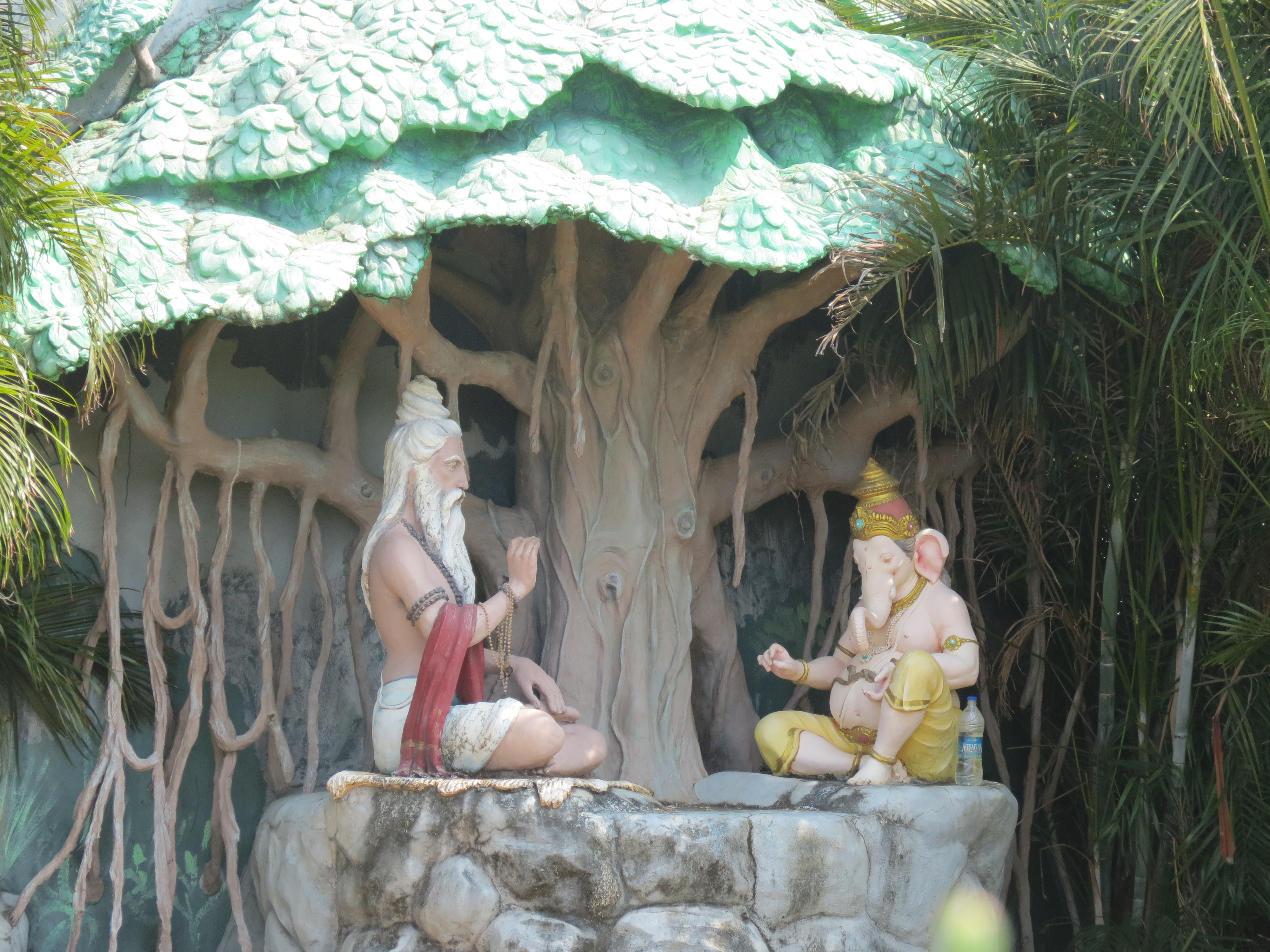
Vyasa dictates the Mahabharata to Ganesha. Statue at the Murudeshwara Temple, Karnataka, India. Artist unknown (n.d.).
Vyasa and Ganesha were sitting under a tree, discussing the whole of the Mahabharata. They had been sitting there for twelve years, but Ganesha interrupted so much that they hadn’t even gotten to the story of Shantanu.
“Well,” said Ganesha, “can you tell me about the whole Ganga, Bhishma, Shantanu affair? What do you think of that whole mess?”
“I don’t think so,” replied Vyasa. “Now when Shantanu tried to stop Ganga from drowning Bhishma, nearly everybody agreed that he had royally screwed up. You’re supposed to follow your vows. That’s how you maintain your honor.”
“A man who doesn’t keep his vows, no matter how difficult, is unlikely to receive much in the way of respect from others.”
“So Shantanu was lucky to have been a good king. If he was a mediocre king, he probably would have been laughed at behind his back.”
“Maybe he made up for his breaking of that vow to Ganga by becoming a good king.”
“Oh, he had always been a good king. A little hot-headed but nothing that age and experience wouldn’t fix.”
“Go on about Shantanu,” said Ganesha.
“Shantanu was angry at first when he saw her trying to drown her son.”
“Naturally. This was, what, the eighth child?”
“Something like that.”
“How could someone see that many children die without saying anything? I think that after the first infanticide, I’d voice my concerns.”
“But a vow is a vow. If Shantanu didn’t like the drowning, he shouldn’t have said anything.”
“Seriously? But child-drowning.”
“Hey, I don’t make the rules.” Vyasa shrugged his shoulders. “Once Shantanu had confronted his wife about that,” he continued, “she made clear to him that he had broken his vow. Shantanu was heartbroken when he realized the implications of what he’d done.”
“I’m sure.”
“He thought he would never see his son or his now wife again.”
“Did he?”
“We’ll get to that. Anyway, Ganga excoriated him for breaking his vow. This time, Shantanu didn’t try to defend himself. He could scarcely speak, so distraught was he. Ganga took their son and, rather than drowning him, decided to raise him to be a man. She knew somehow that this was no ordinary person. He was to be a great warrior.”
“A wise one too.”
“Of course. Everyone has heard of him. But few people know how he was raised.”
“How was he raised?” asked Ganesha.
“Don’t you think I’m going to tell you that? Why else have we been sitting here so long?”
“I’m sorry. Go on.”
“Anyway, Ganga took their son and lived with him out in the woods.”
“Like Rama and Sita.”
“Like Rama and Sita,” replied Vasya, exasperated.
“She taught him how to become an able warrior and how to perform penances to the gods, in case he should ever need to. He was a very devout boy. He prayed everyday. In addition, with his mother’s help, he was able to become a great warrior. More than once, in his youth, he had to fight off a rakshasa or a wild animal. Some say that he was able to thread a needle with an arrow from a mile away.”
“Do you believe that?”
“I wouldn’t be surprised. Bhishma and his mother didn’t live too far from civilization. A village sat a few miles away. Often, the villagers, knowing that there were very special people living in the forest, went to Bhishma and his mother and asked for their advice. Bhishma always gave a level-headed answer. He didn’t want to see anyone hurt or treated unjustly. In this way, he became an able jurist and could spot the crux of any predicament.”
“So he was wise and strong: the two most important qualities in a king.”
“If he had been a king, he would have done very well for himself and for his kingdom.”
“It’s a shame.”
“Yes, indeed, but what can one do? We all have our destinies.”
“What happened to Bhishma after he left the woods?”
“Well, you already know he left the woods eventually. He wasn’t a hermit forever. When Bhishma came of age, he was by then a tall, strapping warrior. Ganga knew it was time to present him to his father.”
“Tell me what happened then.”
“That’s a story for another day. It’s getting late.”
The sun was sinking low on the horizon and the air was growing cold. Vasya and Ganesha each took their leave. Ganesha was eager to hear the next part, while Vasya was glad to finally get some shuteye.
Author’s Note
In this story, I wanted to provide a perspective similar to that of Sita Sings the Blues, an animated film adaptation of the Ramayana. While the gods seem to be all knowing, it is more interesting for me to see one of them (Ganesha) discuss the events of the Mahabharata with another important figure (Vasya). Because I based this story on one of the Amar Chitra Khan comic books, I had enough leeway to provide Bhishma with a childhood different from the one described in the Mahabharata. Like Rama, I gave him some trials and tribulations to go through, so that he could become a more able ruler and warrior. Rather than having Ganesha and Vyasa function smoothly as notetaker and storyteller, respectively, I decided to make Ganesha a rather difficult person to tell a story to. This creates a more interesting situation than if everything had been told smoothly without pauses.
Bibliography


