Showing posts with label Week 4. Show all posts

Sunday, September 18, 2016

Feedback Focus


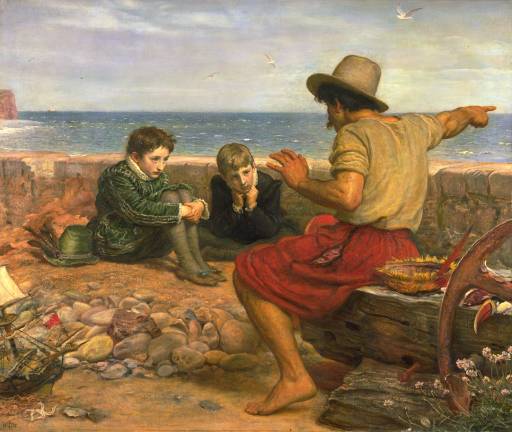
The Boyhood of Raleigh (1871). Painting by John Everett Millais. Source.


Reading Aloud: Why Dog and Cat are Enemies

One of the primary things I noticed was the rhythm of the writing. As I read it, I could imagine a parent or a grandparent telling this story to a child. Reading aloud was more interesting than reading it silently. I'm sure that reading it aloud is closer to the way in which these stories were originally spread. The style is difficult to describe, but it matches Aesop's fables and fairy tales, in that the plot is very straightforward and introduces elements in the same order that they have an effect on the story. for example, the dog and cat are introduced when they plays their roles, rather than being introduced at the very beginning of the story before the plot has actually kicked off. Although these notes are more detailed after having read it aloud, I don't think the story is long enough to make a significant difference. Reading aloud a longer story, such as the Ramayana, would help me create a much more detailed list of notes.

Copy-and-Delete: Bucchettino

Reading Notes
Bucchettino is already shown to be an obedient and thus good kid. Is this penny a lucky reward for his obedience to his parents?
He's thoughtful and thrifty. He knows the value of money.
Now there's an ogre. His rhythmical speaking must be a way in which he lures children to their fates. He's certainly persistent about the figs.
Bucchettino, despite his obedience to his parents, is being punished. Perhaps the moral of the story is to obey parents and not strangers.
Bucchettino is a clever boy. He's saved by his intelligence.
After being tricked by the ogre, the boy tricks the ogre.

This strategy is similar to the way in which I create my reading notes. That is, I'll add notes after reading a few paragraphs rather than after reading the whole chapter or section of chapters. It lets me provide a more detailed analysis and allows me to see what I was thinking after such and such paragraph when I'm reviewing those notes later.

Use a Timer: Quest for the Throne

At first, I read through the story and the author's note. After that, I read through the section about the king's curse.  One addition that would be interesting for the story is for some of the undamaged cargo to wash up on the shore. Through the items that the residents find, another mystery concerning the survivor's past could be created. A longer description of the king's immoral deeds would be a welcome addition. Unfortunately for this reading style, I found myself trying to beat a clock more than focusing on the story. This is similar to my mindset during tests. I'm so worried about finishing in time that I'll think more about the clock than the material and begin to overlook smaller details.

Conclusions
Overall, I have to rank the reading techniques in the following order:
1. Copy-and-delete
2. Reading aloud
3. Use a timer

By thinking in terms of individual lines and paragraphs, rather than the story as a whole, I feel like I can make a more detailed analysis. Any time constraints simply distract from the material. I would have read the story within ten minutes regardless of whether I had actually set a timer, but setting that timer gave me one more thing to think about and to distract me.

Tuesday, September 13, 2016

Story: Kumbhakarna's Diary

The rakshasas try to wake up Kumbhakarna (17th century). Author unknown.
Link.

Dear Monkey,

I’m not one for keeping a diary, but I’ve so many things that I want to put down. I can’t keep all of these emotions bottled up. I think that if I did try to keep everything contained, I would only end up exploding one day and hurting everyone around me.

The problem started a long time ago, when Ravana wanted us to meditate on Brahma so this god would grant us each a boon. I was relatively accepting of this. Who wouldn’t want a gift from Brahma? On the other hand, I didn’t want to spend so much time meditating. I’d rather go hiking or knit a sweater. Imagine how many saris I could have made for the rakshasas dames had I spent that time in Lanka! Eventually, we had thought enough on Brahma that he appeared and said he would grant us our boons.

When Brahma asked what I wanted, I tried to say, “better skills in painting,” but what came out of my mouth was something completely different: “to sleep for twenty-four hours every day.” As I learned later, the goddess of speech, Saraswati, forced my tongue to ask for something foolish. Ravana, to his credit, protested. He wanted that “boon” to not be granted. Brahma relented (somewhat) and made it so that I would wake up for a short while every six months. As an aside, that’s one of the reasons I don’t write in this diary much.

Well, a long time passed and Rama appeared on the scene. He and my brother, Ravana, got into quite the tiff. Ravana told me all about it and called Rama names, but the prince seemed fine to me. He hadn’t done me any harm, anyway. What turned me against Rama was when he invaded Lanka with his monkey armies. I’m more peaceful than your average rakshasa, but that really got my goat. I had never invaded Rama’s kingdom. Why should he invade mine?

The battle had raged on for a while by the time Ravana and his rakshasa servants were able to wake me. I had been having a dream about some delicious curry dishes and, not having eaten for almost six months, I was famished. The rakshasas made me mountains of food. They weren’t the best chefs, but it was certainly filling. Once they had buttered me up like this, Ravana told me that Rama and his armies were at the castle walls. Naturally, I was pretty angry. With the help of a few hundred rakshasas, I prepared myself for battle and went out to meet Rama. He didn’t even wait to hear me out. He just started throwing his weapons at me. How rude! He may be a great warrior, but he’s no diplomat!

Rama and his armies tried to hurt me for about an hour. I’ve got skin several yards thick, so nothing could hurt (or so I thought). I laughed off all they threw at me. Sugriva the monkey king eventually tore off my ear, as though Rama, already deaf to words of peace, wanted to make his opponent literally deaf. It hurt terribly and I was in shocked. That’s when Rama pulled out his secret weapon: some magic arrows. He nocked these arrows and pulled back the string. Then he fired them at me!
I felt like I was going to die, the arrows were so sharp. I fell down on the ground and was unconscious for the next six months.  They must have thought I was dead, as they never even bothered to check my body for a pulse. When I woke up, Lanka was in ruins. I’m writing this from palace, only half-destroyed. I’m glad I was able to find Monkey. I can’t imagine where I’d find another giant diary.

I can’t say I hate Rama anymore. My brother was certainly a jerk about kidnapping Sita, but he would never have actually hurt her. He was probably just playing one of his games. Once he got bored taunting Rama, he would have dropped Sita off. Maybe he went too far this time. Rama and Ravana should have talked it out by reasonable people. There wasn’t any need to kill thousands of rakshasas and burn whole towns to the ground.

It looks like my waking hours are coming to an end. In a few minutes, I’ll fall back asleep for another six months. I can barely keep my eyes open already.


Author's Note

Like one of my previous stories, I used a diary/journal entry to tell the story of a minor character. After reading an Amar Chitra Katha comic book about Ravana's brother, the giant Kumbhakarna, I thought that he got the short end of the stick. Ravana got to rule over Lanka and go wherever he wanted, but Kumbhakarna was stuck sleeping most of the time. I wanted to give Kumbhakarna an internal life of his own and present him as someone who was more inclined to art than to war.


Bibliography

Rao, Subba, and Das, Nandini. (2015). Kumbhakarna: The Sleeping Giant (volume 528). Amar Chitra Katha. Link.

Reading Notes: Kumbhakarna & Dasharatha (Tuesday)

King Dasharatha on his deathbed. Folio from an edition of the Ramayana (c. 1605). Link.

In "Kumbakharna," one of the minor characters of the Ramayana is given a more detailed story. Rather than simply being Ravana's brother and minion, Kumbakharna is given a personality of his own and his own motivations. Ravana is presented as being rather careless concerning his brother's "boon" (given to him by Brahma) and rather exploitative of Kumbakharna's enormous size. Kumbakharna is presented as slothful and glutinous, is contrast to Rama's fairness and honorability. In this way, the story provides a moral; that is, it negatively depicts the traits of the Rakshasas and positively protrays those of Rama. In addition, the divine beings are shown as often in conflict with one another, whether directly or indirectly. Brahma's boon to Kumbakharna is made foolish with the help of Saraswati, the goddess of speech.

In "Dasharatha," the king is presented as rash to some degree, but also, in time, fair and truthful. He admits his mistakes. Many of his actions have far-reaching consequences: among them, Rama's fourteen year exile. Dasharatha may be considered virtuous to a fault, due to the fact that his following Kaikeyi's demands led to Rama's exile and the kingdom's downturn. Dasharatha is "avenged" by the fact that, though Kaikeyi did exile Rama, her son was not the ultimate ruler of the kingdom. Instead, Rama eventually takes his rightful place on the throne. Dasharatha is one of the more complex characters. Rather than being purely good, he is shown as usually having the right intentions but, at times, causing hardship across the kingdom.


Bibliography

Chandrakant, Kamala. (2014). Dasharatha: The Story of Rama's Father (volume 570). Amar Chitra Katha.

Rao, Subba, and Das, Nandini. (2015). Kumbhakarna: The Sleeping Giant (volume 528). Amar Chitra Katha.

Monday, September 12, 2016

Reading Notes: Sita Sings the Blues (Monday)

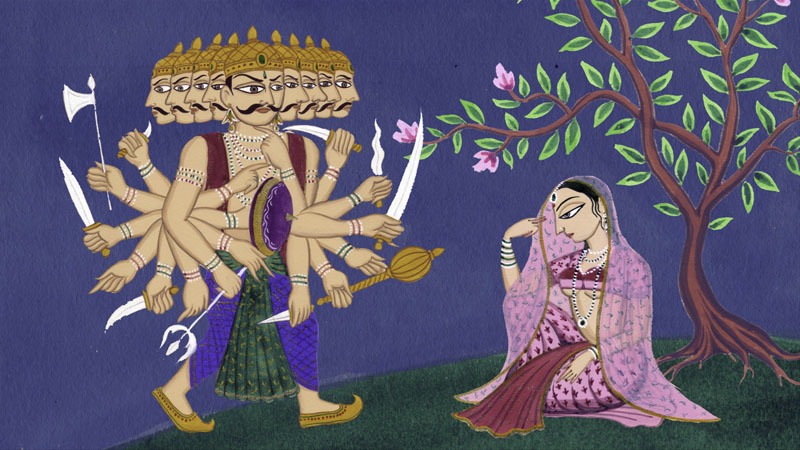
Ravana confronts Sita. Still from Sita Sings the Blues (2009).
Source: Wordpress

The intermingled visual and storytelling styles of this film mirrors the variety of styles in which the Ramayana has been told. One of the first section is a colorful, almost psychedelic presentation of the cosmos. Three celestial beings are shown introducing the story of the Ramayana and discussing it as would a group of friends. They offer a commentary throughout the film and provide it with a surprisingly modern commentary, such as on the idea of “purity” in women. They provide humor to a story that, in almost every aspect, lacks it. Among other things, they discuss the vehicle by which Rama and Sita returned to the kingdom and compare it to airplanes.

Laced throughout the story of the Ramayana are sections devoted to the story of a couple who are separated for some time when the man (Dave) is sent to India as part of a business contract. The story of this couple is divided in such a way that its depiction of separation and reunion come around the same time that Rama and Sita are separated and reunited. The title refers to various musical sections in the film in which “Sita” sings early jazz or swing love songs whose lyrics reflect the story of Rama and Sita.

Given that the Ramayana is an ancient story, it seems inevitable that it should be told over the years in a variety of styles and in a variety of cultures. While the story of this couple doesn’t necessarily capture the same level of desperation that a kidnapping would cause, it does display one of the themes of the Ramayana in a way that’s likely more relatable to modern audiences. Few of us will have to rescue a loved one from a demon king.

That layer of modern commentary is the most interesting aspect of this film to me. Through this, the film becomes much more than an animated adaptation of the Ramayana.


Bibliography


Paley, Nina. Sita Sings the Blues, 2009. Link.