Showing posts with label Week 8. Show all posts

Tuesday, October 11, 2016

Week 8 Growth Mindset


In college, I’ve found that I tend towards highly structured subjects. Classes such as economics and calculus tend to be easier to study than, say, a class on Chekhov or British literature. This is largely because economics and calculus require that I learn the fundamental concepts and build on those. In other words, I can’t learn about basic supply and demand concepts and move immediately to econometrics.
What makes classes such as this (Epics of India) different is that I often have to come up with something completely new, rather than following very specific instructions to reach one number or one precisely worded answer. The weekly storytelling posts are a great example of this. While I do get some source material to work with, I can’t apply a formula and get the answer. It takes a lot of imaginative/literary thinking in order to complete the assignment and produce a full story.
Entering this class, I thought that I’d be terrible at pulling ideas out of thin air. There have been a few weeks when it took a lot of time to come up with an idea for an assignment, but I’ve found that I can come up with decent ideas much faster than before. I remember agonizing over the very first storytelling assignment of this class. Now, it seems that I can find an interesting perspective in the source material and expand on it within my own story.
This isn’t the only improvement I’ve made. In addition to coming up with stories faster, I’ve found that I can better analyze the stories we read. In other literature classes, I was able to come up with only a few interesting points. Having spent so much time writing notes over the Ramayana, the Mahabharata, and other stories, I’ve found that I can provide notes on, not only my opinion of characters, but of potential threads and trends throughout the story.
I used to think that I was almost hopeless when it came to literary analysis. The fact that I felt so hopeless probably stopped me from taking more literature classes. All it took to improve this skill and give me more confidence in these sort of open-ended assignments was trying. I’m more than glad I took this class. It’s made me try harder at something I thought I hadn’t much aptitude for. In order to improve this skill further, I plan to read those stories that don’t seem (at first) to offer easy adaptations. For example, a story with limited characters is more likely to prove difficult to adapt than one with dozens. This isn’t such a large change now that I’ve written several adaptations of the epics, but it’ll still make a large difference.

Monday, October 10, 2016

Week 8 Reflections

image%2B(2).jpeg
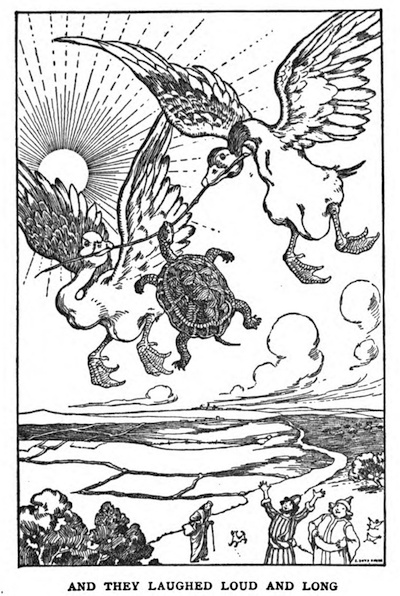
The Tortoise is carried away by the Geese. Illustration by E. Boyd Smith. Published in The Tortoise and the Geese and Other Fables of Bidpai by Maude Barrows Dutton (1908).

Reading

I think that I have been making good choices in terms of my reading. While I’m sure I’d enjoy the Narayan versions of the Ramayana and Mahabharata, picking the public domain versions allowed me to get an idea of how different the storytelling styles are. Reading the lyrical versions of these two epics is likely more authentic, in that the stories were likely told as songs, just like The Odyssey or The Iliad.

I have to admit that the sheer number of names and places of the Mahabharata made it difficult to follow along. For this and other reasons, I preferred the Ramayana. The Ramayana, in being focused on a smaller number of characters, seemed to be able to provide a more intimate account of the people involved. I could more easily image how Rama would react to events than Arjuna. I tend to read books that are focused on small sets of characters rather than huge set pieces and (literal) armies of characters. This makes my preference for the Ramayana less surprising.

When I read books that aren’t part of a school assignment or a class, I rarely take notes. This is half the result of a disinclination towards doing so and half not wanting to write on a book. The latter used to seem almost sacrilegious. It took a lot of English and literature classes before I started to take good notes that were more than just vague statements. While I don’t take notes on a regular when it comes to my free-time reading, I find myself critically analyzing small passages and thinking about them a lot more as I continue on in the book.

The note that I’m taking in this class are really helping. Rather than writing my thoughts after I’ve read the passages for that day or that week, I take notes whenever some line or some situation intrigues me. In this way, I can record my more precise thoughts on the story, rather giving my general feelings about it. In addition, these more precise notes allow me to come up with story ideas based on relatively minor events (such as Arjuna and Hanuman’s meeting). I can look back at my notes and use an idea that I’ve written about to create a story.

I intend to focus my reading efforts on folktales. While great kings and warriors are all well and good, I’d like to read more of those stories that relate to those of more humble origins. In reading these folktales, I’d get a perspective of the royalty and of the commoners. The specific tales I’d focus on are the Hindu legends, such as Dutton’s Fables of Bidpai.