Showing posts with label Week 14. Show all posts

Wednesday, November 30, 2016

Story: The Young Parrot and the Farmer

Screen Shot 2016-11-28 at 4.10.32 PM.png
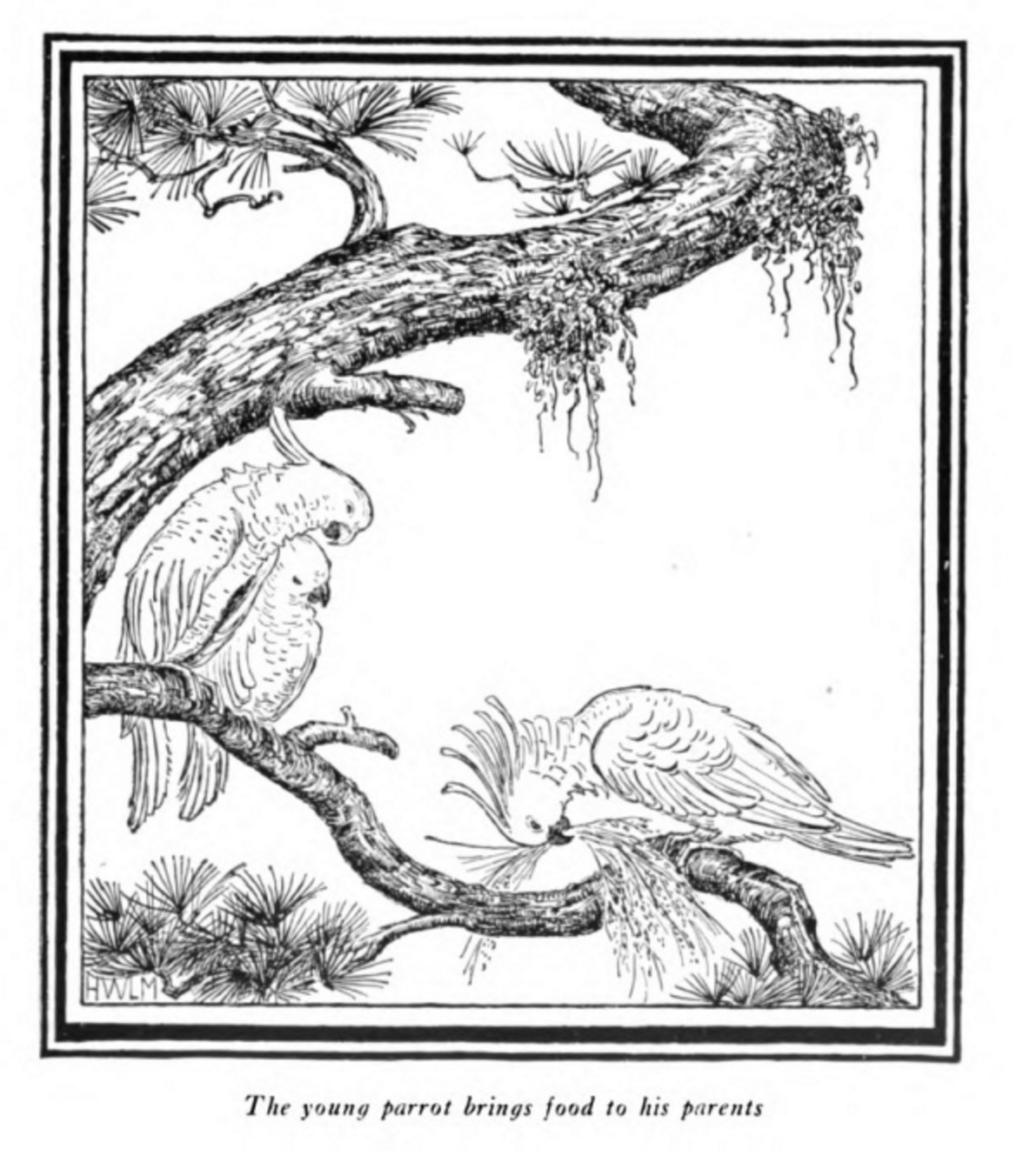
“The young parrot brings food to his parents.” Scene from “The Young Parent.”
Illustration by H. Willebeek Le Mair (1939).


The Young Parrot and the Farmer

One day, a flock of parrots were on a farmer’s field, eating all of the loose rice. However, they left the plants alone. The farmer’s servant was out there and saw one of the younger parrots gathering a great deal of rice in its beak, but not eating it. Once the birds had left, the servant went to tell the farmer about it.
The farmer was surprised by this and said to his servant, “Trap this parrot, but do not kill it. I want to speak to it and see why it is storing away rice.”
Before the parrots returned the next day, the servant set up the trap.
Suddenly, the young parrot felt itself caught. It looked down and saw a piece of string wrapped around its foot. It struggled and bit at the string, but it was unable to free itself. The servant, who had been waiting in the bushes, grabbed this parrot and took it to the farmer.
The bird was frightened but didn’t struggle.
“What is this?” the farmer cried. “A bird who is not scared of humans?”
“No, I’m not afraid of humans” the young parrot replied. Both the farmer and his servant were shocked. A talking parrot? “I’m only afraid of not being able to return to my parents.”
“Why are you afraid of that?”
“Because they cannot fly and if I do not return to them, they will surely starve for lack of rice.”
“So you are storing up the rice in your beak for them?”
“Yes, I store it up each time my flock and I find a field of rice.”
“How honorable,” replied the farmer. “I thought of keeping you as a pet, but I will let you go, so that you may serve your family.”
“Thank you,” replied the young parrot. “I and my kind will never forget this kind deed. If you ever need help, simply whistle three times and my flock will come to your aid.”
Several weeks passed. By now, the farmer’s fields were rich with rice. It was sure to be one of the best harvests in centuries. While the farmer was out admiring his fields, he saw a dark cloud on the horizon.
“How odd,” he thought. “The monsoon season is not close and yet there is a huge dark cloud coming towards my farm.”
As this “cloud” drew closer, the farmer realized what it truly was. The buzzing of the cloud could be heard from miles away.
“Locusts!” the farmer cried.
He despaired at this. It was just his luck that a swarm of locusts would eat his best harvest. He had no idea what to do. He would never be able to stop all of them. The locust swarm landed in his neighbor’s fields and began to eat everything there. The farmer almost lost all hope, but then he remembered the promise that the young parrot had made some time ago.
The farmer whistled three times as loud as he could and soon a whole flock of parrots flew down from the forest.
The young parrot came to him and asked, “What do you need, kind farmer?”
The farmer pointed out the swarm but a mile or two away. He said, “There is a swarm of locusts that has descended on my neighbor’s farm. You must eat all of them or the whole countryside will be ravaged and hundreds will starve.”
The parrots flew off in a hurry. Within a few minutes, all of the locusts had either fallen to the ground, dead, or had been gobbled up by the parrots.
When the young parrot returned to the farmer, the farmer said, “You have saved me, my family, and the entire village. You may eat of my fields whenever you like.”
Every year after this, not a single locust descended on the farmer’s fields and the flock of parrots always had enough to eat.


Author’s Note

I adapted this story from “The Young Parrot,” in Twenty Jataka Tales. In the original story, the young parrot saves rice for his parents, is trapped by the farmer, and is later set free. I decided to expand on this story by having the farmer be rewarded for his kindness. In the original story, the parrot only thanks him for his kindness and flies off. Karma plays a large role in my adaptation. Not only is the parrot set free because of his sense of familial obligation, but the farmer and the rest of the village are saved because the farmer performed a kind deed.  

Bibliography

Noor Inayat (Khan). (1939). Twenty Jataka Tales.


Tuesday, November 29, 2016

Reading notes: Twenty Jataka Tales (Part B)


The flying horse from “The Goblin Town” flies the sailors home. Illustration by H. Willebeek Le Mair (1939).

The Two Pigs
  1. Even though the mother is surrounded by drunken men, she refuses to give up her adopted pig-children. Loyalty to family is a common theme in these tories.
  2. The men treat the pigs as people and are rewarded with a more peaceful society.

The Patient Buffalo
  1. This monkey is extremely annoying. Surely, the buffalo will get some form of justice.
  2. The buffalo is rewarded for not using his great power to hurt the weak or act sadistically.

The Sarabha
  1. Although the king tries to hunt the Sarabha and kill it, the Sarabha tries to help him.
  2. The Sarabha sees the king suffering and knows that it must help him as it would a family member.
  3. This king does not forget the help he has received. For every good deed, the person or animal who performed it is rewarded.

The Goblin Town
  1. I think the sailors who stayed are justified in that decision. If strange horse-bird creatures flew down from the heavvens, I’d be wary of riding it.
  2. How will the men who stayed fare? Will they be eaten by goblins or will they be able to fend the goblins off?

The Great Elephant
  1. The elephant sacrifices himself when he sees men in dire need.
  2. The elephant gets the short end of the stick in this situation. Being remembered doesn’t seem like a great reward for sacrificing himself.
  3. What would happen if the elephant had played a trick on them and never sacrificed himself? What if he had just lied about the elephant body because he was mischievous?

The Quarrelsome Quails
  1. This story is a lot like the other animal king ones. If the king’s subjects listen to him, they will never be harmed.
  2. The quails who cause internal strife in the flock are punished with death.

The Forest Fire
  1. The little quail may not be physically strong, but he has enough power to push back flames.
  2. I expected the quail to die because he didn’t do what his parents wanted and eat the insects.

The End of the World
  1. The hare overreacts, but he isn’t punished for it.
  2. He’s made an honest mistake and the lion seems to forgive him.

The Golden Goose
  1. While a king may be majestic, nothing lasts forever.
  2. The goose seems to indicate that wealth and promises are beholden to the passage of time.

The Noble Horse
  1. The horse asks for mercy for the other kings.
  2. This mercy is likely given only because the horse was great in battle. How would the horse’s request have been received if the horse hadn’t done much?

Bibliography

Noor Inayat (Khan). (1939). Twenty Jataka Tales

Monday, November 28, 2016

Reading Notes: Twenty Jataka Tales (Part A)

Screen Shot 2016-11-28 at 4.10.32 PM.png


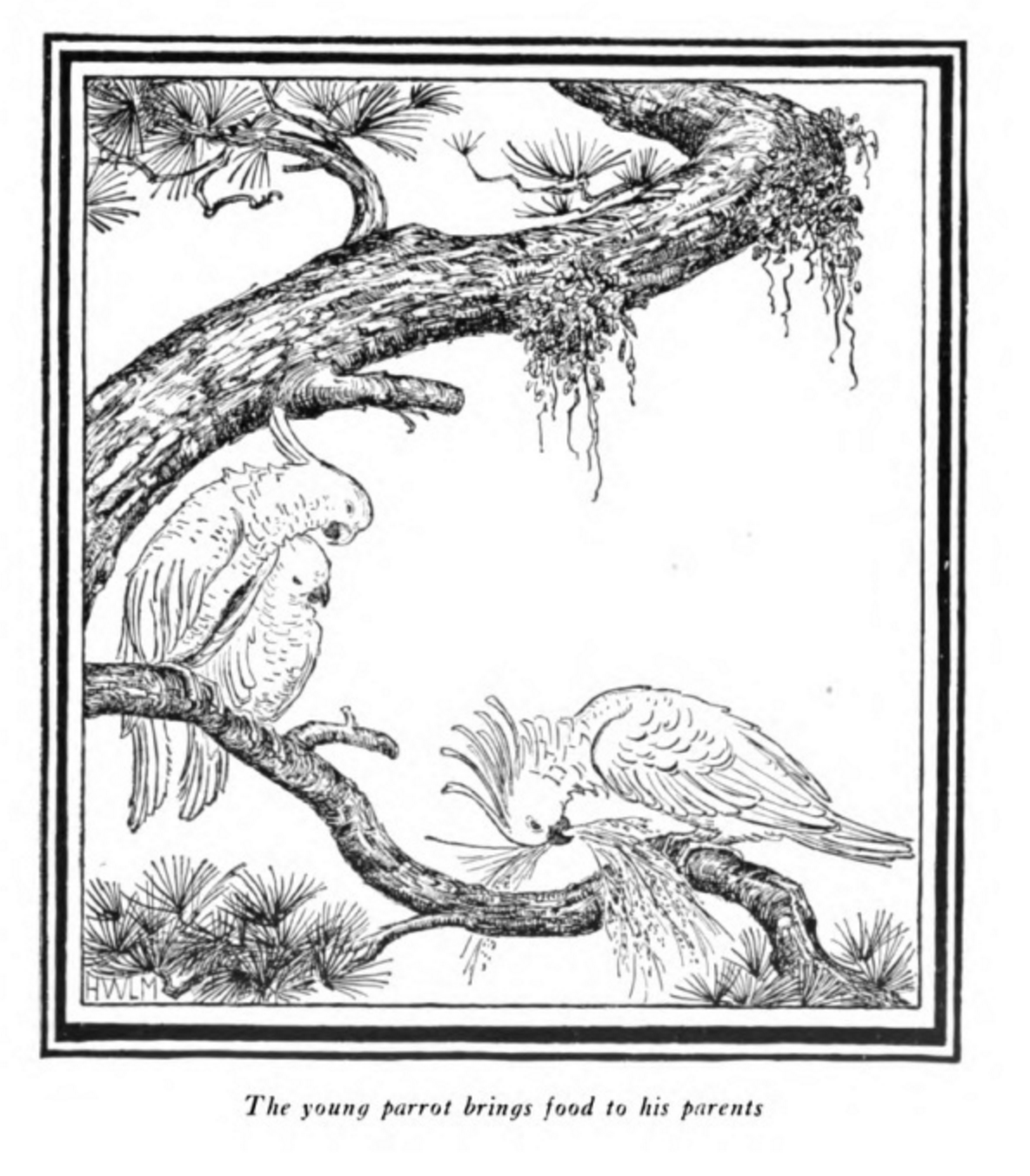
“The young parrot brings food to his parents.” Scene from “The Young Parent.”
Illustration by H. Willebeek Le Mair (1939).

The Monkey-Bridge
  1. These monkeys live in a paradise. Given the nature of stories like this, it’s likely that this paradise will be destroyed due to one of the monkey’s carelessness.
  2. Is the king greedy for the fruit or appreciative of its greatness?
  3. The humans are soiling previously untouched nature.
  4. The monkeys were careless and so are punished. However, their wise king will help them survive.
  5. The humans and the monkeys are punished for intruding on nature and having allowed this intrusion, respectively.

The Guilty Dogs
  1. Like the previous story, there is a wise king who wants to protect his subjects. In most of these stories, all of the problems could be solved if the subjects had only listened to the king.
  2. However, in this story, one of the kings (the human one) is rash. It is only through wise arguments that he comes to the proper decision.

Banyan
  1. Mercy will probably be rewarded.
  2. The king also decides to spare the deer. As always, mercy proves more honorable than violence.

The Tortoise and the Geese
  1. The tortoise was rash in his speaking.
  2. He’s punished for speaking (or trying to speak) in anger at the children.

The Fairy and the Hare
  1. Each of the animals is generous, but the hare is the most generous among them.
  2. This is because he offers, not his property, but his life, in order to help other people.
  3. Of course, there’s someone (a fairy) there with the power to test him and punish him or reward him.  

The Golden Feathers
  1. Why did the husband not reveal his identity? That would have ensured that he wasn’t forcibly plucked of his feathers.
  2. The mother is ungracious for fortune’s gifts and is punished for it. Are the daughters punished for not stopping her?

The Young Parrot
  1. The other parrots might be punished for not helping the young parrot and for being cowardly.
  2. What would happen if the field-owner needed help in the future? Doesn’t he deserve something in return for having let the young parrot go?

The Empty Lake
  1. With a good enough king, it seems that the people will never suffer long.

The Swan Kingdom
  1. It is good to be wary of too beautiful lakes.

The Master's Test
  1. This was adapted in one of the Amar Chitra Katha comic books.
  2. Although respect for and obedience to one’s elders is important, absolute obedience is not good.
  3. This moral lesson isn’t surprising when one considers all of the unwise brahman and rash kings that pop up in Indian folktales and epics.


Bibliography

Noor Inayat (Khan). (1939). Twenty Jataka Tales.